Best Espresso Machines With Built-In Grinder 2026: The All-in-One Round-Up
- An all-in-one is a deliberate compromise: one appliance and less counter space, but a grinder that has to be simplified to fit
- Semi-automatic to learn and grow: De'Longhi La Specialista Arte Evo (699.90 EUR) or Sage Barista Pro (829.90 EUR)
- Assisted tamping and comfort: Sage Barista Express Impress (829.90 EUR)
- Bean-to-cup, one touch and it is served: Philips Series 3200 LatteGo (price not published by the manufacturer) or Gaggia Cadorna Prestige (price not published by the manufacturer)
- Top-tier semi-automatic: De'Longhi La Specialista Maestro (1,599.99 EUR) or Sage Barista Touch Impress (1,299.90 EUR)
- For the same money, a dedicated grinder plus a separate machine usually pours a better cup. The combo wins on practicality, not on the very peak of quality
Which espresso machines with a built-in grinder are worth buying in 2026?
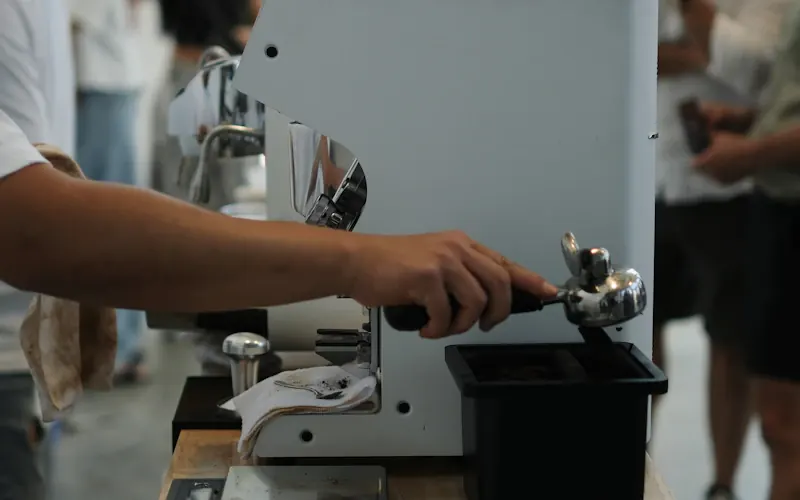
Start with a distinction most pages blur, and which decides everything at the till. An espresso machine with a built-in grinder is not the same animal as a bean-to-cup automatic. The first is a semi-automatic: it grinds and doses, then you tamp, pull the shot and steam the milk. The second does the lot at one touch, grinding included, with no portafilter in sight. Both carry a grinder inside the housing, but they court very different drinkers. Here is our 2026 selection, with manufacturer prices in EUR checked on 8 November 2026 at the official Belgian online shops of De'Longhi and Sage (list price, excluding promotions), Philips and Gaggia publishing no price; they are offered as a snapshot, since retail prices move with stock and promotions. Euros, not a currency-converted guess, because this is written for a European and Belgian audience.
| Model | Type | Grinder | Manufacturer price (checked on 8 November 2026) | Best for | Buy |
|---|---|---|---|---|---|
| De'Longhi La Specialista Arte Evo | Semi-automatic, built-in grinder | Conical, 15 settings | 699.90 EUR | Learning with hands on the shot | Check price on Amazon |
| Sage Barista Pro | Semi-automatic, built-in grinder | Baratza conical, 30 settings | 829.90 EUR | The all-in-one reference, daily espresso | Check price on Amazon |
| Philips Series 3200 LatteGo | Bean-to-cup automatic | Ceramic, 12 levels | price not published by the manufacturer | One touch, zero effort, auto milk | Check price on Amazon |
| Gaggia Cadorna Prestige | Bean-to-cup automatic | Ceramic, user profiles | price not published by the manufacturer | Italian bean-to-cup, saved profiles | Check price on Amazon |
| Sage Barista Express Impress | Semi-automatic, built-in grinder | Conical, assisted tamping | 829.90 EUR | Consistent dosing and tamping | Check price on Amazon |
| De'Longhi La Specialista Maestro | Semi-automatic, built-in grinder | Conical, Sensor Grinding; EC9885.M: stainless steel burrs, 15 settings | 1,599.99 EUR | Demanding enthusiast, LatteCrema, deep manual control | Check price on Amazon |
* These links may earn a commission if you make a purchase, at no extra cost to you. Manufacturer prices checked on 8 November 2026 at the official Belgian online shops (list price, excluding promotions); retail prices vary by retailer and colour. Learn more.
Which all-in-one suits which budget?
First tier: the smart entry into espresso with a grinder
Two philosophies share this bracket. On the semi-automatic side, the De'Longhi La Specialista Arte Evo (699.90 EUR) is the most complete entry point: a built-in conical grinder with 15 settings, a dosing and tamping guide and three temperature levels. It leaves the tamping and the shot to you, which makes it a genuine learning machine at a contained price. The EC9255.M EX:2 version sold in 2026 adds Cold Extraction technology, which makes a cold brew in under 5 minutes and sits on the front dial alongside espresso, americano and hot water. It has a 1.7 l water tank and a 15 bar pump, and its barista kit combines the dosing and tamping guide with a metal tamper and a tamping mat, next to a manual steam wand for milk. The Sage Barista Pro (829.90 EUR) is, to my taste, the all-in-one reference here: a near-instant ThermoJet heating system, a thirty-setting Baratza conical grinder and an LCD that walks you through the dose. It is the machine I recommend most often to anyone wanting to improve without overspending. The Barista Pro (BES878) pairs low-pressure pre-infusion with extraction at 9 bar, driven by an Italian 15 bar pump and PID temperature control. Its water tank holds 1.9 l and its hopper 250 g of beans, and Sage covers it with a 2-year limited warranty. On the bean-to-cup side, the Philips Series 3200 LatteGo (price not published by the manufacturer) aims at the opposite drinker: coffee at one touch, milk foam included via the easy-clean LatteGo system, a twelve-level ceramic grinder and not a portafilter to manage. The EP3246/70 version of the Series 3200 LatteGo uses 100% ceramic grinders rated for at least 20,000 cups and a fully removable brew group. It has a 1.8 l water tank, a 275 g bean container and a 15 bar pump; with the AquaClean filter it makes up to 5,000 cups without descaling, based on 8 filter replacements.
What to avoid in this range: machines sold as bean-to-cup but fitted with a token grinder that barely adjusts. Without grind control the espresso stays flat. A well-dialled Arte Evo beats a low-cost automatic with a frozen grind every time.
Second tier: comfort and a polished bean-to-cup
The Gaggia Cadorna Prestige (price not published by the manufacturer) is a fully featured Italian bean-to-cup: a colour TFT screen, a broad drinks menu, saved user profiles and a ceramic grinder. It suits the household that wants bean-to-cup convenience with a little personalisation. Its 100% ceramic grinder adjusts over 10 positions, and the Optiaroma function sets the amount of ground coffee on 5 levels; 4 user profiles store personalised drinks from a menu of up to 15, including coffee over ice. Designed and made in Italy, the machine carries a 0.6 l integrated milk carafe with automatic cleaning, a 1.5 l water tank, a 300 g bean container and a 15 bar pump. On the semi-automatic side, the Sage Barista Express Impress (829.90 EUR) adds the Impress assisted tamping: a lever that applies a consistent, repeatable pressure, removing one of the biggest sources of inconsistency for a beginner. For anyone who wants the barista's control without botching the tamp every other morning, that is a real gain. The assisted tamp on the Barista Express Impress (BES876) applies a constant 10 kg of pressure to the coffee dose with a 7° twist. Its steel conical grinder has 25 grind settings and intelligent dosing, which corrects the next dose automatically from the last grind and tamp. Heating comes from a 1,600 W Thermocoil with PID temperature control at 93 °C, not a ThermoJet as on the Barista Pro; the water tank holds 2 l, the hopper 250 g of beans, and Sage provides a 2-year repair, replace or refund guarantee.
Beyond 1200 EUR: the demanding enthusiast tier
At this level two semi-automatics stand out, at 1,599.99 EUR and 1,299.90 EUR manufacturer price. The De'Longhi La Specialista Maestro (1,599.99 EUR) carries Sensor Grinding, which calibrates the ground dose to the chosen fineness, plus the LatteCrema system for quality automatic milk foam, while keeping deep manual control. As of 8 November 2026, De'Longhi Belgium sells La Specialista Maestro under the reference EC9885.M, whose product page does not mention Sensor Grinding: it lists 15 grind settings with stainless steel burrs and adds a cold brew made in under 5 minutes. The EC9885.M also integrates a Smart Tamping Station, which tamps at even pressure without spills, an advanced Thermoblock ready in under 20 seconds, dynamic pre-infusion and 5 brewing temperature profiles. The Sage Barista Touch Impress (1,299.90 EUR) pairs the Impress assisted tamping with a touchscreen on which up to 8 personalised drinks can be created, saved and named, shot volume, milk texture and milk temperature included. The Barista Touch Impress (BES881) carries a European Baratza precision grinder with 30 grind settings, a 340 g hopper, a 2 l water tank and ThermoJet heating ready in 3 seconds. Its Auto MilQ automatic frothing has settings for cow's, almond, oat and soy milk. The choice is philosophical: the Maestro leans toward guided manual craft, the Touch Impress toward a recipe recalled at a tap.
Where does a shared body help the shot, and where does it hold it back?
Let me say the part that round-ups tend to dodge. For the same budget, a dedicated grinder plus a separate machine pours a better cup than a combo in most cases. The reason is mechanical: to house a mill in the same body as the boiler and the pump, the maker shrinks the burrs, simplifies the adjustment range and limits heat dissipation. A 300 EUR grinder sitting next to an entry-level machine produces a more even particle distribution, and therefore a cleaner extraction, than a built-in grinder of the same total cost folded into one appliance.
So why buy an all-in-one at all? For three concrete and entirely fair reasons. First, footprint: one appliance on the counter instead of two, which matters enormously in a small kitchen. Second, entry cost: at the lower end a combo costs less than a machine plus a grinder of comparable quality. Third, simplicity: one plug, one cleaning routine, one grind-to-portafilter path with nothing to decant.
Two consequences of the shared body only surface later. Grind changes travel slowly, because the adjustment sits on the same chassis as the group and a new setting needs a dose or two before the cup reflects it. Repairs travel badly as well: the appliance leaves for service with the mill inside, so the kitchen loses both functions at once.
The honest verdict fits in a sentence. If you chase the absolute peak of quality and counter space is no object, go for a separate machine and a dedicated grinder. If you want excellent everyday espresso without crowding the kitchen or juggling two appliances, a good all-in-one like the Sage Barista Pro will take you a very long way, far past where most drinkers ever arrive.
Which checks matter most when one appliance grinds and brews?
Five things tell you how well the mill and the group have been matched inside one body.
Semi-automatic or bean-to-cup: this is the first call. The semi-automatic (portafilter) asks for technique and rewards practice with a far better cup. The bean-to-cup automatic does everything at one touch, ideal for convenience and volume, but caps lower on espresso finesse.
Grinder quality: favour conical burrs with a genuine adjustment range, at least 25 settings on the Sage side: 25 on the Barista Express Impress, 30 on the Barista Pro and the Barista Touch Impress. A frozen grinder or one with too few steps permanently throttles the extraction.
Heating system: a ThermoJet or equivalent reaches temperature in seconds, which transforms the morning routine and the thermal stability from cup to cup.
Milk system: a manual steam wand (Sage Barista Pro, one to master) for latte art, or an automatic frother such as LatteGo and LatteCrema (Philips, De'Longhi Maestro) for simplicity.
Maintenance: a combo concentrates mill and brew group, so regular burr cleaning and descaling decide its lifespan. Favour brands with service and parts available in Europe.
What do buyers get wrong most often with a grinder-equipped espresso machine?
- Confusing semi-automatic and bean-to-cup: they are not the same gestures or the same result. Know which morning you want before you pay.
- Buying a bean-to-cup for latte art: most foam the milk automatically, with no steerable wand. Latte art needs a manual steam wand.
- Reaching for the top tier before you know your taste: a machine at 1,299.90 EUR or more only makes sense if you genuinely enjoy the barista ritual. Start lower and climb later.
- Neglecting the grinder, assuming the machine compensates: no boiler fixes an uneven grind. The built-in grinder remains the heart of the cup.
- Forgetting the running cost: filtered water, descaler, burr cleaning. A poorly maintained combo degrades fast, mill and brew group at once.
Frequently asked questions about espresso machines with a grinder
What is the best espresso machine with a built-in grinder in 2026?
It depends on budget and type. Among semi-automatics: De'Longhi La Specialista Arte Evo (699.90 EUR) to start, Sage Barista Pro (829.90 EUR) as the all-in-one reference, Sage Barista Express Impress (829.90 EUR) for assisted tamping, De'Longhi La Specialista Maestro (1,599.99 EUR) or Sage Barista Touch Impress (1,299.90 EUR) at the top. Among bean-to-cup automatics: Philips Series 3200 LatteGo (price not published by the manufacturer) and Gaggia Cadorna Prestige (price not published by the manufacturer). For the same money a separate grinder plus a machine usually pours a better cup, but the combo wins on simplicity and counter space.
What is the difference between a semi-automatic with grinder and a bean-to-cup machine?
A semi-automatic with a built-in grinder (Sage Barista Pro, De'Longhi La Specialista) grinds and doses, but you tamp, pull the shot and steam the milk: it teaches the barista's craft and has a very high ceiling. A bean-to-cup automatic (Philips 3200 LatteGo, Gaggia Cadorna Prestige) does everything at one touch, with no portafilter, favouring convenience over control. Semi-automatic to learn, bean-to-cup for daily simplicity.
Is an all-in-one built-in grinder as good as a separate grinder plus machine?
For the same budget, usually not. A built-in grinder is a packaging and cost compromise, with smaller burrs and a narrower adjustment range than a 300 EUR standalone. A separate setup often grinds more evenly, and so extracts more cleanly. The all-in-one wins back on three points: less counter space, lower entry cost, simpler to live with. The choice is between peak cup quality and everyday practicality.
Which espresso machine with grinder should a beginner buy?
To start with hands on the shot, the De'Longhi La Specialista Arte Evo (699.90 EUR) or the Sage Barista Pro (829.90 EUR) are the best semi-automatic entry points: a built-in grinder and real room to grow. For zero effort, the Philips Series 3200 LatteGo (price not published by the manufacturer) bean-to-cup is the better call. Avoid stretching to 1,299.90 EUR or more before you know you enjoy the barista ritual, or dropping to a machine with no proper adjustable grinder.
Sources
- De'Longhi Belgium, La Specialista Arte Evo (EC9255.M EX:2), product page, accessed 8 November 2026
- Sage Appliances Belgium, the Barista Pro (BES878), product page, accessed 8 November 2026
- Philips Belgium, Series 3200 LatteGo (EP3246/70), product page, accessed 8 November 2026
- Philips, EP3246/70 product documentation (PDF), accessed 8 November 2026
- Gaggia, Cadorna Prestige, product page, accessed 8 November 2026
- Sage Appliances Belgium, the Barista Express Impress (BES876), product page, accessed 8 November 2026
- De'Longhi Belgium, La Specialista Maestro (EC9885.M), product page, accessed 8 November 2026
- Sage Appliances Belgium, the Barista Touch Impress (BES881), product page, accessed 8 November 2026
- Sage, the Barista Touch Impress instruction book (SES881, PDF), accessed 8 November 2026
Ready to choose your built-in grinder machine?
See the best machines on Amazon →Further reading: Best espresso machines 2026 · Best coffee grinders 2026 · Specialty coffee FAQ
Affiliate links: as an Amazon Associate, expertcafe.be earns from qualifying purchases at no extra cost to you. Learn more.