Best Coffee Grinders 2026: Ranked by Budget and Use
- The grinder shapes the cup more than the machine does, so it should take priority in any budget
- Under 200 EUR: Baratza Encore ESP (versatile electric, 179.95 EUR) or 1Zpresso JX-Pro (premium manual, price not published by the manufacturer)
- 200 to 300 EUR: Comandante C40 MK4 (259 to 299 EUR depending on finish), the travel and premium filter reference
- Above 300 EUR: Eureka Mignon Specialita (flat burrs, espresso, price not published by the manufacturer), DF64 Gen 2 (flat single dose, 313 EUR, i.e. 349 USD converted at the ECB reference rate of 6 November 2026) or Niche Zero (conical, versatile, 670 EUR, i.e. 559 GBP converted at the ECB reference rate of 6 November 2026)
- Never buy a blade grinder, whatever the budget
Which coffee grinders are worth buying in 2026?
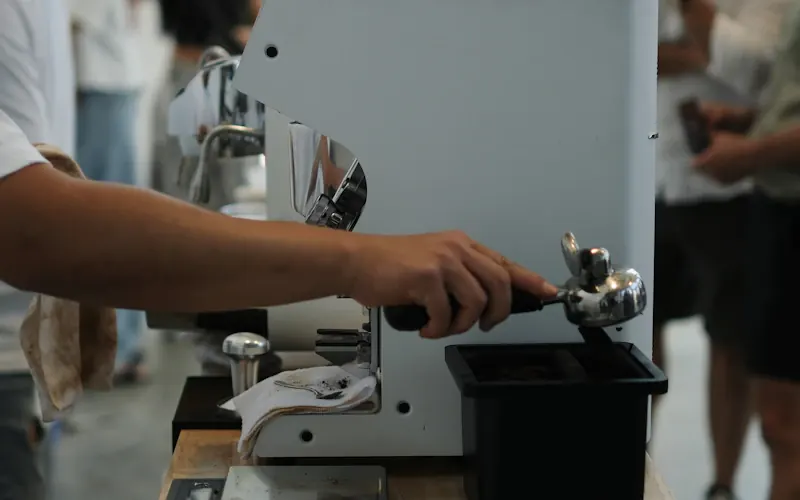
The decisive moment in a cup of coffee lasts a fraction of a second. A roasted bean meets the burrs, breaks apart, and the spread of fragment sizes that falls out of the chute decides almost everything you will taste afterwards. I once watched a barista in Antwerp pour two espressos from the same beans, the same machine, the same dose, the same time, and they tasted like different coffees entirely. The only variable was the grinder. That is the quiet truth this whole category turns on: you are not buying a kitchen gadget, you are buying the gatekeeper of flavour.
After working through grind-quality tests, extraction trials and the kind of long-term reliability that only shows up after a few hundred shots, here is our selection of the best coffee grinders in 2026. Every model below uses burrs, conical or flat, which is the one condition we treat as non-negotiable. Prices are the list prices published by each manufacturer on its official shop, checked on 8 November 2026: prices published in US dollars (DF64) or pounds sterling (Niche Zero) are converted into euros at the ECB reference rate of 6 November 2026 and rounded to the euro, while Eureka and 1Zpresso publish no price for these models. Retail prices can differ.
| Grinder | Type | Burrs | Manufacturer price (checked 8 November 2026) | Best for | Buy |
|---|---|---|---|---|---|
| Baratza Encore ESP | Electric | Conical 40 mm | 179.95 EUR | Beginner to enthusiast, filter and espresso | Check price on Amazon |
| 1Zpresso JX-Pro | Manual | Conical 48 mm | price not published by the manufacturer | Beginner to enthusiast, filter and travel | Check price on Amazon |
| Comandante C40 MK4 | Manual | Conical Nitro Blade | 259 to 299 EUR depending on finish | Enthusiast, travel, premium filter | Check price on Amazon |
| DF64 Gen 2 | Electric | Flat 64 mm | 313 EUR (349 USD converted at the ECB reference rate of 6 November 2026) | Single dose, espresso and filter, upgradeable burrs | Check price on Amazon |
| Eureka Mignon Specialita | Electric | Flat 55 mm | price not published by the manufacturer | Semi-pro espresso, intensive daily use | Check price on Amazon |
| Niche Zero | Electric | Conical 63 mm | 670 EUR (559 GBP converted at the ECB reference rate of 6 November 2026) | Serious home barista, single dose, espresso and filter | Check price on Amazon |
* These links may earn a commission if you make a purchase, at no extra cost to you. Learn more.
Which grinder makes sense at which budget?
Under 200 EUR: the smart entry into burrs
This bracket sets two characters against each other: the versatile electric and the high-quality manual. The Baratza Encore ESP (179.95 EUR) is the electric reference. It runs 40 mm conical burrs, splits its adjustment into micro-steps for espresso and macro-steps for filter, and ships with a 54 mm dosing cup plus a 58 mm adapter ring that drops grounds straight into a portafilter. What makes it quietly remarkable is repairability: Baratza sells spare parts for a wide range of repairs, with availability varying by model and product age, and publishes step-by-step repair videos, so this is a grinder you mend rather than replace. The Baratza Encore ESP is designed in Seattle (United States) and manufactured and assembled in Taiwan. In Belgium it carries a 2-year manufacturer warranty, reserved for the first buyer and domestic use. Its burrs turn at 550 rpm, the hopper holds 300 g of beans, the grounds bin 120 g, and the grinder measures 13 x 15 x 34 cm. The 1Zpresso JX-Pro (price not published by the manufacturer) is the manual answer, with 48 mm conical burrs (the maker lists stainless steel among the grinder's materials without specifying the burr's) and an adjustment of 12.5 microns per click. Its filter grind shames many electric grinders at twice the price. The cost is in your forearm: budget around forty turns for a fifteen gram dose, which is meditative on a slow Sunday and tiresome before a Monday commute. 1Zpresso's limited warranty covers defects in materials and workmanship for one year on all its grinders. The JX-Pro S specification gives a weight of 778 g and a capacity of 30 to 35 g of coffee. The grinder comes apart without tools for cleaning, with no need to recalibrate the burr. As of 8 November 2026, the official JX-Pro page presents the JX-Pro S, which differs only by a folding handle, and lists it as out of stock and unavailable; the model no longer appears in the maker's store, which points espresso users to the J-Ultra (8 microns per click).
What to refuse outright in this range: any blade grinder. A 30 to 50 EUR machine chops beans into ragged fragments by impact. The result is unpredictable and the cup is uneven, and no recipe tweak rescues a grind made by a propeller.
200 to 300 EUR: the peak of manual grinding
The Comandante C40 MK4 (259 to 299 EUR depending on finish) sits in a class of its own. Built in Germany, its Nitro Blade burrs are cut from a high-nitrogen, high-alloy stainless steel, hardened and tempered, that holds an edge through years of use, and they deliver a particle distribution tuned specifically for fresh specialty arabica. The stainless steel body is built to be dropped in a bag rather than babied, the click adjustment locks settings repeatably, and each unit arrives with two jars, one dark glass and one unbreakable polymer for travel. Its natural home is pour-over, the V60, Chemex and Kalita, where grind consistency translates directly into clarity in the cup. It will pull espresso too, though dialling in fine settings by hand asks more patience than an electric grinder demands. The manufacturer price is 259 EUR for the Black finish (out of stock on 8 November 2026), 269 EUR for the coloured finishes and 299 EUR for the wood finishes. Each supplied jar holds 40 g of coffee. The maker's starting points are 7 to 13 clicks for espresso and 18 to 35 clicks for filter, and an optional Red Clix axle refines the steps. Comandante sells spare parts and runs a repair service for accidental damage.
Above 300 EUR: the serious home barista tier
Cross 300 EUR and three philosophies appear. The Eureka Mignon Specialita (price not published by the manufacturer) runs 55 mm flat burrs and is rated by its maker for all-purpose use, from Turkish grind to French press with espresso in between: a bright, defined cup, a famously quiet operation and the kind of stepless dial that makes micro-adjustments feel effortless during intensive daily use. The Eureka Mignon Specialità, as the maker spells it, has a 310 W motor turning at 1350 rpm, weighs 5.6 kg and stands 350 mm tall. Eureka rates the burr life at 300 kg. Its stepless micrometric adjustment works on the lower burr, so the grinder can be serviced without losing the setting, and the burr carrier comes off by removing 9 screws. The DF64 Gen 2 (313 EUR, i.e. 349 USD converted at the ECB reference rate of 6 November 2026, for the 220 V EU-plug version) brings 64 mm flat burrs into single-dose territory: a built-in ionizer tames static, an anti-popcorn disc steadies the feed, retention stays low, though the brand publishes no figure and says it varies with coffee, humidity and cleanliness, and crucially the 64 mm platform accepts aftermarket SSP burrs for those who like to tinker. The Turin brand, which sells the DF64, backs it with a one-year warranty. Its 250 W motor runs at a fixed speed, stops automatically after 45 seconds and does not weigh the dose. The brand gives a weight of about 15 lb (6.8 kg) and a capacity of about 50 g with the bellows. According to Turin, units ordered or received after July 2026 are the DF64 Gen 2.7, with a revised chute, ion-generator probes along the grounds path and a convex anti-popcorn blocker. The Niche Zero (670 EUR, i.e. 559 GBP converted at the ECB reference rate of 6 November 2026, sold across Europe direct from the manufacturer) takes the conical route: 63 mm burrs, an infinite dial and a straight-through path that leaves almost nothing behind, which makes it the dream of anyone who switches origins constantly. Its cup is round and forgiving. The Niche Zero weighs 4.1 kg and measures 122 x 211 x 311 mm. It ships with a 58 mm dosing cup, a socket screwdriver and a brush. Its official manual (edition 25.07.18) gives a burr life of more than 750 kg. Orders shipped outside the United Kingdom leave without UK VAT, and local taxes and duties are payable by the buyer. The decision among the three comes down to character and workflow: daily espresso and clarity point to the Eureka or DF64, while versatility and frequent single dosing point to the Niche.
How do two burr shapes end up making two different particle curves?
Flat burrs are two parallel horizontal discs that shear the beans between their faces. They produce a bimodal particle distribution, two clustered size peaks, which favours a clean extraction with bright aromatics and a well-defined acidity. They generate more friction heat and tend to hold more coffee between the discs, which is why they suit grinders built for continuous or high-volume use, and why static and retention management matter so much on flat-burr machines like the DF64 Gen 2.
Conical burrs work with a cone spinning inside a fixed ring. They run cooler, run quieter, retain very little coffee and give a rounder, fuller cup with softer aromatic edges. They are the more versatile shape: they handle espresso, filter, AeroPress and French press with equal ease. The Niche Zero, the Comandante and the Baratza all sit in this camp, which is part of why they forgive a wider range of brew methods.
The practical summary: if you make mostly espresso on a capable machine and chase maximum precision, lean toward flat burrs (Eureka Mignon Specialita, DF64 Gen 2, or professional tiers like the Mahlkönig E65S). If you change brew method or origin often, conical burrs offer more versatility with a gentler learning curve.
What tells you, before buying, how evenly a grinder will cut?
Burr size: wider burrs mean higher throughput and less heat per gram. Past roughly 50 mm (flat) or 55 mm (conical), you are entering professional territory, which is where the Niche Zero (63 mm) and DF64 Gen 2 (64 mm) earn their cup quality.
Adjustment range: an espresso grinder needs very fine control, micro-adjustments of a few microns at a time. A filter grinder can live with broader steps. The best offer either stepless (infinite) adjustment or very fine steps, thirty or more clicks per rotation.
Retention: the amount of coffee left in the grind path after each dose. High retention (five grams or more) is a real problem for single dosing and for anyone changing origins often, which is exactly the deficiency the Niche Zero and DF64 Gen 2 are engineered to minimise.
Noise: flat-burr grinders are generally louder (65 to 75 dB) than conical ones (50 to 65 dB). The Niche Zero, a conical grinder, is rated by its maker at 72 dB during grinding, above that conical range, so for early apartment mornings a quieter conical or the deliberately hushed Eureka is the kinder housemate.
Burr alignment and wear: two burrs held perfectly parallel cut the whole charge into the same size band. A small misalignment widens the spread and lifts the share of fines, which shows up in the cup as a muddier, less separated extraction. Wear does the same thing over years rather than seconds, and the tell is simple: when you have to grind finer than usual to reach your normal flow time, the burrs are near the end of their life.
Repairability: a repairable grinder is always worth more than a sealed one at the same price. Baratza is exemplary here, selling parts for a wide range of repairs, with availability varying by model and product age, and documenting the repairs on video.
Which mistakes cost buyers the most when choosing a grinder?
- Buying a blade grinder: whatever the brand or price. Blades chop, they do not grind, and the particle distribution is impossible to control.
- Underspending on the grinder: an 800 EUR espresso machine fed by a 50 EUR grinder is wasted money. Reinvesting in a Baratza Encore ESP transforms the very same machine.
- Buying a filter-only grinder for espresso: fine espresso settings (particles around 200 to 400 microns) demand a grind range that pure filter grinders do not cover properly.
- Ignoring the brand for servicing: favour brands that sell spare parts and support customers in Europe, so a worn burr does not retire the whole grinder.
- Confusing speed with quality: a slower grinder (300 to 450 rpm) extracts aromatics with less friction heat. Raw speed is not a quality signal in itself.
Frequently asked questions about coffee grinders
What is the best coffee grinder in 2026?
There is no single best grinder, only the best for your budget and method. Under 200 EUR, the Baratza Encore ESP (179.95 EUR) is the most versatile electric pick and the 1Zpresso JX-Pro (price not published by the manufacturer) the standout manual. At 259 to 299 EUR depending on finish, the Comandante C40 MK4 leads for filter. Above 300 EUR, the Eureka Mignon Specialita (price not published by the manufacturer) excels at espresso, the DF64 Gen 2 (313 EUR, i.e. 349 USD converted at the ECB reference rate of 6 November 2026) at flat-burr single dosing, and the Niche Zero (670 EUR, i.e. 559 GBP converted at the ECB reference rate of 6 November 2026) at low-retention versatility. The one rule that always holds: choose burrs over blades, even at entry level.
Are flat or conical burrs better for espresso?
For espresso, flat burrs (Eureka Mignon Specialita, DF64 Gen 2) tend to give a clean, defined cup with bright, well-separated flavours, thanks to a more uniform particle distribution. Conical burrs (Niche Zero, Baratza, Comandante) deliver a rounder, softer, more forgiving profile with less heat. Flat burrs reward precision and clarity; conical burrs reward versatility and ease. Both work beautifully for espresso once you cross the 300 EUR mark, so it comes down to the cup character you prefer.
Why does the grinder matter more than the coffee machine?
The grinder sets the extraction surface and the consistency of the particles, which the machine can only work with, never fix. An uneven grind, as a blade grinder produces, creates over-extracted (bitter) and under-extracted (sour) particles in the same shot at once, and no machine corrects that. This is why baristas invest more in the grinder than the machine: for a 1000 EUR setup, a 60-40 split favouring the grinder beats an 80-20 split favouring the machine.
Which coffee grinder should a beginner buy for under 200 EUR?
Under 200 EUR, the Baratza Encore ESP (179.95 EUR) is the most versatile pick: 40 mm conical burrs, micro-steps for espresso and macro-steps for filter, and repairability backed by spare parts for a wide range of repairs, with availability varying by model and product age. As an alternative, the 1Zpresso JX-Pro (price not published by the manufacturer, unavailable from the maker on 8 November 2026) is manual but grinds better than many electric rivals in the same bracket. Avoid any blade grinder completely, even at 50 EUR, because it chops rather than grinds and makes extraction impossible to control.
Sources
- Baratza, Encore ESP, official product page (Belgium), accessed 8 November 2026.
- Baratza, warranty (Belgium), accessed 8 November 2026.
- Baratza, Encore ESP manual (PDF), accessed 8 November 2026.
- Baratza, How we keep Baratza grinders out of the landfill, accessed 8 November 2026.
- 1Zpresso, JX-Pro product page (JX-Pro S), accessed 8 November 2026.
- 1Zpresso, J series grinders, accessed 8 November 2026.
- 1Zpresso, FAQ, accessed 8 November 2026.
- Comandante, C40 MK4 Nitro Blade Racing Green, official shop, accessed 8 November 2026.
- Comandante, C40 MK4 Nitro Blade Black, official shop, accessed 8 November 2026.
- Comandante, C40 MK4 Nitro Blade manual (PDF), accessed 8 November 2026.
- Comandante, FAQ, accessed 8 November 2026.
- Turin Grinders, DF64 Gen 2, product page, accessed 8 November 2026.
- Turin Grinders, DF64, international 220 V version, accessed 8 November 2026.
- Eureka, Mignon Specialità, official product page, accessed 8 November 2026.
- Eureka, Mignon Specialità, technical sheet (PDF), accessed 8 November 2026.
- Niche Coffee, Niche Zero, official product page, accessed 8 November 2026.
- Niche Coffee, shipping policy, accessed 8 November 2026.
- Niche Coffee, Niche Zero manual (PDF), accessed 8 November 2026.
- Mahlkönig, E65S, accessed 8 November 2026.
- European Central Bank, euro foreign exchange reference rates (rates of 6 November 2026), accessed 8 November 2026.
Ready to choose your grinder?
See the best grinders on Amazon →Further reading: Coffee grinder guide: flat vs conical, settings and diagnosis · Single-dose grinding and retention · Grind size by brew method · Best manual coffee grinders 2026
Affiliate links: as an Amazon Associate, expertcafe.be earns from qualifying purchases at no extra cost to you. Learn more.