☕ Three key facts
- Turkish coffee culture was inscribed on the UNESCO Intangible Cultural Heritage list in 2013, recognising five centuries of hospitality rituals, coffeehouse tradition, and craft knowledge.
- The cezve requires the finest grind used in any brewing method, with the median particle sitting below 100 microns, and a slow climb that stops short of a rolling boil while the foam (köpük) is raised two to three times.
- Sugar is added before heating, not after: this is a technical requirement for proper foam stability and flavour integration, not simply a matter of preference.
Turkish Coffee and Ibrik Guide: Cezve Technique, Ottoman History, UNESCO Heritage
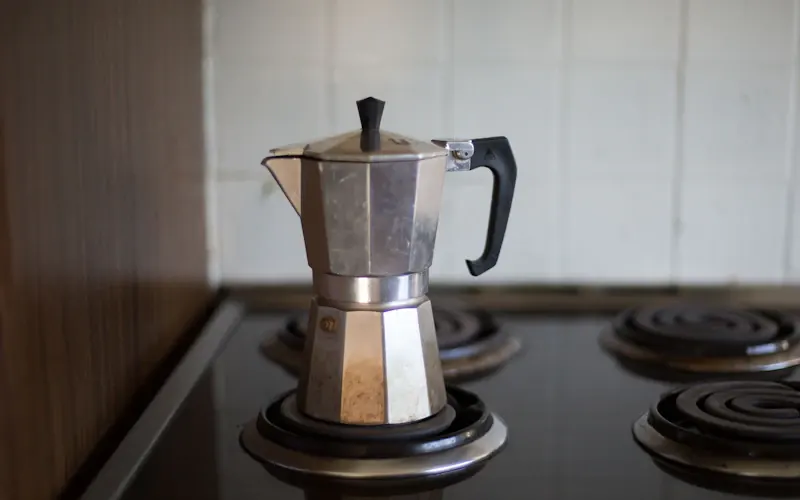
Turkish coffee is a brewing method in which very finely ground coffee is combined with cold water in a small, long-handled pot called a cezve and heated slowly until the surface approaches boiling. No filter separates the coffee grounds from the liquid: the marc remains in the cup and settles to the bottom during drinking. This technique originated in the coffeehouses of Istanbul (Turkey) and Cairo (Egypt) in the mid-sixteenth century and has since spread across the Mediterranean basin, the Middle East, and Eastern Europe, giving rise to distinct regional traditions in Greece, Lebanon, Syria, and the countries of the Arabian Peninsula.
A copper or tin-lined brass cezve (15 to 25 €) with a capacity of 150 to 300 ml is the standard vessel. The grinder is the real constraint: the setting has to sit well below the espresso range, which most domestic burr grinders never reach. A low and controllable heat source, whether a gas flame on the lowest setting or an induction hob at minimum power, is required to manage the critical foam-raising stage.
Why did UNESCO inscribe Turkish coffee culture?
In December 2013, the UNESCO Intergovernmental Committee for the Safeguarding of the Intangible Cultural Heritage met in Baku (Azerbaijan) and voted to inscribe Turkish coffee culture on its Representative List. The dossier submitted by Turkey described not only the brewing technique itself but also the entire social architecture surrounding it: the coffeehouse (kahvehane) as a civic institution, the ritualised hospitality of offering coffee to guests, the practice of tasseography (reading fortunes in dried coffee grounds), and the transmission of cezve craftsmanship across generations of coppersmiths.
The inscription rests on a long documentary trail. The Ottoman chronicler Peçevî İbrahim Efendi records the first Istanbul coffeehouses opening in the Tahtakale district in 1554 and 1555, under Süleyman the Magnificent, run by two merchants from Aleppo and Damascus (Syria). Cairo (Egypt), Damascus and Mecca already had coffee houses earlier in the century. These kahvehane quickly became venues for games, music and political talk, which is why Sultan Murad IV had the Istanbul coffeehouses demolished in 1633 and made public consumption a capital offence; the ban did not outlive his reign. Coffeehouses then appeared in London (England) in the 1650s, as a fairground stall in Paris (France) in 1672, and in Vienna (Austria) on 17 January 1685, under a licence granted to Johannes Diodato, an Armenian merchant from Ottoman territory. The popular story crediting Georg Franz Kolschitzky with founding the first Viennese coffeehouse using sacks abandoned after the 1683 siege is a later embellishment, traced to a 1783 account by Gottfried Uhlich. Viennese coffee house culture has been listed on Austria's national inventory of intangible cultural heritage since October 2011, a national listing rather than a place on the UNESCO Representative List.
Why is the pot called a cezve rather than an ibrik?
The vessel for Turkish coffee is the cezve (Turkish and Arabic: جزوة), a small pot with a long handle, a wider base, and a slightly narrowed neck that encourages foam to rise and concentrate at the surface. Traditional cezves are made of copper, often with a tin lining on the interior to prevent chemical interaction between oxidised copper and the acids present in coffee. Brass models are also common. The long handle, typically made of metal or wood, keeps the hand away from the heat source during the critical foam-raising stages.
The term "ibrik" has created lasting confusion in specialty coffee vocabulary. In Arabic, ibrik (إبريق) refers to a spouted pitcher or ewer, an entirely different object used for pouring water or liquids. Its adoption in Western specialty coffee circles, particularly in the United States during the 1990s and 2000s, to describe the cezve is technically imprecise. Both terms now circulate freely in English-language coffee discourse, and the Specialty Coffee Association competition carries both of them: it runs as the World Cezve/Ibrik Championship, staged at World of Coffee Dubai in January 2026. For accuracy, "cezve" remains the correct designation.
Why must Turkish coffee be ground finer than espresso?
Turkish coffee demands the finest grind of any brewing method. In The Craft and Science of Coffee, von Blittersdorff and Klatt (2016) place the median particle diameter for Turkish coffee below 100 microns, where espresso, itself one of the finer methods, is normally set somewhere between 200 and 400 microns. Icing sugar is the reference texture, not semolina. The reason is structural rather than ceremonial: with no filter, no mechanical pressure and a brew that stays under 95 °C, only an extremely large contact surface releases enough soluble material in the few minutes available.
The practical implication is severe. Most domestic burr grinders, espresso models included, bottom out somewhere between 200 and 300 microns and will not travel further. Two routes stay open. A traditional Turkish hand mill, whose screw-adjusted conical burrs reach far lower settings than a kitchen espresso grinder, gets there. Failing that, pre-ground Turkish coffee sold in vacuum packs is consistent and needs no equipment at all.
| Turkish term | Meaning | Sugar quantity | Flavour profile |
|---|---|---|---|
| Sade | Plain, unsweetened | 0 g | Bitter, earthy, intense |
| Az şekerli | A little sweet | 1/2 teaspoon | Lightly sweetened, bitterness present |
| Orta | Medium sweet | 1 teaspoon | Balanced, round, most popular |
| Çok şekerli | Very sweet | 2 teaspoons | Syrupy, sweet-forward, coffee in background |
How do you brew Turkish coffee step by step?
The brewing process begins with cold water, not hot. Coffee (approximately 10 g per 80 to 100 ml of water, a ratio of 1:8 to 1:10, enough to fill one or two fincan of 60 to 80 ml), water, and sugar are added together to the cezve at room temperature. The sugar must be incorporated before any heating begins: this is not merely a tradition but a technical requirement. Dissolved cold, sugar integrates fully with the extracted compounds during the temperature rise, producing a more stable foam and a smoother mouthfeel. Sugar added to a finished cup does not achieve the same chemical integration.
The cezve is placed over a very low heat source. The temperature climbs slowly toward but never reaches full boiling (100 °C). At approximately 90 to 95 °C, the surface begins to foam. This foam (köpük in Turkish) is the primary quality signal: abundant, dense, dark brown foam indicates a correctly prepared coffee. The cezve is removed from heat at the first rise of foam, a small spoonful of foam is distributed into each cup (a traditional hospitality gesture ensuring equal foam for each guest), and the cezve is returned to the heat for a second and sometimes third foam rise. The coffee is then poured slowly and carefully, minimising disturbance of the marc.
How is Turkish coffee served, and what happens to the grounds?
Turkish coffee is traditionally served with a glass of cold water. The water is consumed before the coffee to cleanse the palate, ensuring the flavour of the coffee is tasted on a neutral base. A piece of Turkish delight (lokum) or another sweet confection often accompanies the cup, providing a sweetness counterpoint between sips. In formal hospitality settings, the order in which guests receive their coffee (elder first, guest of honour first) follows social protocols still observed in rural areas of Turkey and across much of the Middle East.
After drinking, the cup is traditionally turned upside down onto the saucer and allowed to cool. When the marc has dried and set, the cup is righted and the patterns of dried grounds on the interior of the cup and saucer are interpreted. This practice, known as tasseography or tasseomancy, is widely followed in Turkey, Lebanon, Greece and across the diaspora communities of these countries, and belongs to the social custom around the cup rather than to any reliable reading. The 2013 UNESCO inscription explicitly includes this divinatory tradition as an element of the intangible heritage of Turkish coffee culture.
Which regional versions of cezve coffee exist?
The technique of cezve-brewed coffee has given rise to a family of regional variants across the Middle East and North Africa. The most widespread modification is the addition of cardamom (Elettaria cardamomum) to the coffee grounds before brewing. This practice is dominant in the Arabian Peninsula, where the resulting beverage is called qahwa and is prepared with lightly roasted or green beans alongside generous amounts of ground cardamom, sometimes accompanied by saffron. In Beirut (Lebanon) and Damascus (Syria), rose water or orange blossom water may be added. In the Gulf states, qahwa is typically served unsweetened in small handle-less cups and accompanies dates. That Arabic tradition holds its own UNESCO listing, inscribed in 2015 as "Arabic coffee, a symbol of generosity" on a joint nomination from Saudi Arabia, the United Arab Emirates, Oman and Qatar.
South-eastern Anatolia takes the method to its limit with mırra, from the Arabic murr, meaning bitter. Drunk around Mardin, Şanlıurfa, Gaziantep and Adana, it uses twice-roasted beans and a long boil until the liquid thickens, takes no sugar at all, and is served a few millilitres at a time in handle-less cups at weddings and formal receptions.
The method has travelled further than its name. The same cup is ordered as ellinikós kafés in Greece, kypriakós kafés in Cyprus, bosanska kafa in Bosnia and Herzegovina, kafe turke in Albania, and Armenian coffee in Armenia. These labels reflect the political history of each country as much as the kitchen. The technique itself barely varies and goes back to the spread of kahvehane culture across Ottoman territory in the sixteenth century.
Frequently Asked Questions
What is the difference between a cezve and an ibrik?
The cezve is the small, long-handled pot, traditionally made of copper or tin-lined brass, used to brew Turkish coffee. The word "ibrik" refers in Arabic to a spouted pitcher or ewer, an object technically unrelated to coffee preparation. The term was adopted imprecisely in Western specialty coffee circles to mean the cezve. Both words are now used interchangeably in English-speaking coffee contexts, though "cezve" remains technically accurate.
Why is Turkish coffee culture inscribed by UNESCO?
UNESCO inscribed Turkish coffee culture on its Representative List of the Intangible Cultural Heritage of Humanity in 2013. The inscription covers not only the brewing technique in the cezve but also the associated social practices: the coffeehouse tradition (kahvehane), hospitality rituals, the practice of tasseography (reading fortunes in coffee grounds), and the transmission of craft knowledge across generations.
How fine should the grind be for Turkish coffee?
Turkish coffee is ground finer than any other method. Von Blittersdorff and Klatt (2016) place the median particle diameter below 100 microns, against roughly 200 to 400 microns for espresso, and the texture should resemble icing sugar. That fineness maximises contact surface and allows rapid extraction below 95 °C without mechanical pressure. Most domestic burr grinders bottom out around 200 to 300 microns, so a traditional Turkish hand mill or pre-ground vacuum-packed coffee is the practical answer.
Sources
- UNESCO, Representative List of the Intangible Cultural Heritage of Humanity: "Turkish coffee culture and tradition" (decision 8.COM, Baku, December 2013) and "Arabic coffee, a symbol of generosity" (2015).
- Peçevî İbrahim Efendi, Tarih-i Peçevî, the Ottoman chronicle reporting the first Istanbul coffeehouses of 1554 and 1555.
- Von Blittersdorff M., Klatt C. (2016). "The Grind: Particles and Particularities", in B. Folmer (ed.), The Craft and Science of Coffee, Elsevier.
- Austrian Commission for UNESCO, national inventory of intangible cultural heritage, "Viennese coffee house culture" (2011).
- Specialty Coffee Association, World Coffee Championships, World Cezve/Ibrik Championship.