☕ Key takeaways
- Under-extraction produces a sour, salty, watery, hollow cup, the lightest soluble compounds have been extracted but sugars and complex aromatics did not have enough time to dissolve.
- Over-extraction gives a bitter, astringent, dry, fruitless cup, too many phenolic compounds and caffeine have been extracted beyond the pleasant aromatic compounds.
- Corrective variables to adjust in order of impact: grind size (highest impact), water temperature, steep/brew time, coffee-to-water ratio, always change one variable at a time.
Under- vs Over-Extraction Guide: Complete Sensory Diagnosis
3 key takeaways
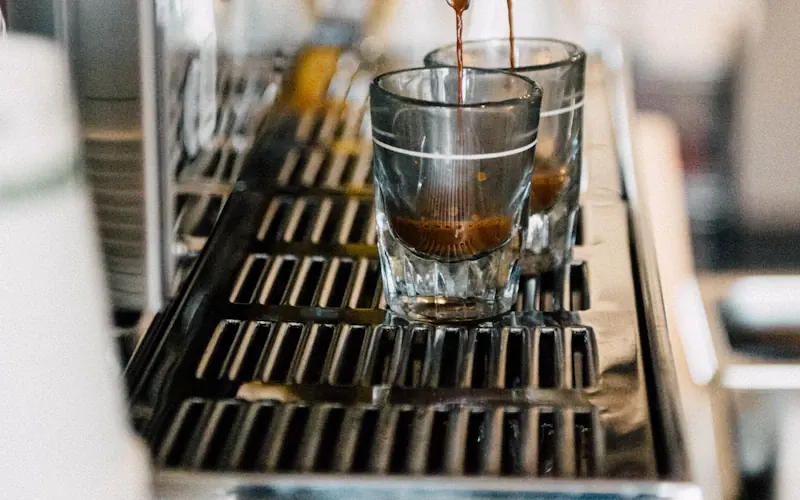
- Extraction is the process by which water dissolves and carries soluble compounds from ground coffee into the cup. Every flavour problem in brewed coffee comes back to that transfer, either too little of it or too much.
- A well-extracted cup carries enough sweetness and body to balance its acidity, and it finishes clean rather than dry. Put in numbers, that means an extraction yield of 18% to 22% of the dry coffee mass.
- The fundamental rule of dialling in: change only one variable at a time. If you adjust grind and temperature simultaneously, you will never know which produced the effect.
Extraction is the process by which water dissolves and carries soluble compounds from ground coffee into the cup. Every flavour problem in brewed coffee, biting acidity, harsh bitterness, lack of body, flatness, traces back to an extraction imbalance: either insufficient (under-extraction) or excessive (over-extraction). This guide gives you the tools to identify the problem through sensory analysis, understand which variable is responsible, and apply the right correction without guesswork.
What does a well-extracted cup actually taste like?
A well-extracted cup carries enough sweetness and body to balance its acidity, and it finishes clean rather than dry. Put in numbers, that means an extraction yield of 18% to 22% of the dry coffee mass: below that the cup stays sour and hollow, above it turns dry and bitter.
One confusion is worth clearing up straight away, because it derails half of all troubleshooting: extraction yield and TDS are not the same measurement. Yield says how much of the ground coffee left the basket and ended up in the cup, as a percentage of dry mass. TDS says how concentrated the resulting drink is, roughly 1.15% to 1.35% for filter and 8% to 12% for espresso. A thick, concentrated shot can still be badly under-extracted. The measurement side has its own guide on this site; here everything is settled by taste.
These numbers stay reference points, not rules. A natural-processed Ethiopian may be delicious at 17% while a dense Robusta needs to go further to open up. The sensory window always takes precedence over the figures.
How does under-extraction show up in the cup?
It shows up as a cup that bites: sharp acidity, a salty edge, thin body and a finish that disappears on the spot. The mechanism is plain enough, the water never had enough contact with the coffee to reach the complex aromatics. What leaves the grounds first are the acids (fruity, winey) and the mineral salts, hence the profile.
Sensory signals of under-extraction:
- Sharp, piercing acidity: like unsweetened lemon juice, not the bright pleasant acidity of a well-made filter. It bites the sides of the tongue and cheeks.
- Saltiness: sometimes distinctly saline, a classic under-extraction marker in espresso.
- Thin, watery texture: lack of body, a diluted feeling even in espresso.
- Simple, underdeveloped aromas: green grass, raw grain, lime zest without complexity.
- Short, hollow finish: flavours vanish immediately after swallowing.
What does over-extraction taste and feel like?
It tastes bitter and it feels dry, and the two arrive together. Over-extraction starts when water keeps working after the desirable compounds are spent. The last molecules to leave the grounds are the most bitter, certain melanoidins and phenolic compounds, which is where the heavy bitterness and the mouth-drying astringency come from.
Sensory signals of over-extraction:
- Intense, persistent bitterness: not the clean brief bitterness of dark chocolate, but bitterness that settles in and stays.
- Astringency: dryness, as if chewing grape skin or oversteeped tea. Saliva seems "captured."
- Dry, powdery texture: the mouth feels parched after swallowing.
- Burnt, ashy aromas: rubber, burnt tobacco, calcined wood.
- Harsh, lingering finish: an unpleasant sensation lasting several minutes.
Which variables move extraction, and in which direction?
Four of them do most of the work, and each pushes extraction in a predictable direction: grind size, water temperature, the coffee-to-water ratio and contact time. Knowing which one moves what is the difference between correcting and guessing.
- Grind size: Finer grind = larger contact surface = faster, more complete extraction. This is the primary lever. Too coarse = under-extraction. Too fine = over-extraction.
- Water temperature: Higher temperature = faster solubilisation. 88°C extracts less and more slowly than 96°C. Too low = under-extraction. Too high = over-extraction.
- Coffee-to-water ratio: A tighter ratio (more coffee, less water) gives a more concentrated drink, but each gram of coffee sees less water and tends to end up less extracted. An open ratio does the opposite: a lighter drink, extraction pushed further, far enough to start pulling the bitter tail compounds.
- Contact time: For filter, the total infusion duration. For espresso, the shot time (25-30 seconds is the classic window). Too short = under-extraction. Too long = over-extraction.
Which cup symptom points to which extraction fault and which fix?
| Sensory symptom | Extraction type | Primary cause | Priority correction |
|---|---|---|---|
| Sharp acidity, lemon without sugar | Under-extraction | Grind too coarse | Go one step finer |
| Salty, saline finish | Under-extraction | Incomplete extraction | Finer grind OR temperature +1-2°C |
| Thin, watery texture | Under-extraction | Ratio too open or time too short | Increase dose or extend time |
| Green grass, raw grain aromas | Under-extraction | Temperature too low | Raise temperature 2-3°C |
| Intense, persistent bitterness | Over-extraction | Grind too fine or time too long | Go one step coarser |
| Astringency, dry texture | Over-extraction | Tannin extraction (end of infusion) | Shorten contact time |
| Burnt, ashy notes | Over-extraction | Temperature too high | Lower temperature 2-3°C |
| Rubber, carbonised wood | Severe over-extraction | Tight ratio + fine grind + long time | Revise the entire recipe from scratch |
How do you dial in by changing one variable at a time?
The fundamental rule of dialling in: change only one variable at a time. If you adjust grind and temperature simultaneously, you will never know which produced the effect. Recommended sequence:
- Identify the main problem: Taste the coffee and identify the dominant symptom. Classify it as under- or over-extraction.
- Adjust grind first: This is the variable with the strongest and most immediate lever. Half a step in the right direction often solves the problem entirely.
- Taste the result: Brew again with only the grind changed. Reassess.
- If still insufficient, adjust temperature±2°C in the indicated direction.
- Last resort: adjust ratio or time: These variables have more complex effects and can interfere with other qualities.
- Document the final recipe: Note the parameters of the successful cup: dose, ratio, grind setting, temperature, time. Consistency comes from reproducibility.
What changes between espresso, filter, AeroPress and moka pot?
The principles hold everywhere; what changes is which variable is actually in charge. Espresso hands the job to grind, filter splits it between grind and pour, immersion methods put it on time.
- Espresso: Grind is the primary lever. Pressure is fixed (9 bars). Time (25-30 s) follows from grind.
- Filter (V60, Chemex, Kalita): Grind and percolation time are the primary levers. Pour technique (flow rate, spiralling, number of pours) also strongly influences the result.
- AeroPress: Highly flexible. Press duration, grind, temperature, and ratio can all vary. The ideal diagnostic tool for experimentation.
- French press: Steep time and grind coarseness are the two key variables. Coffee remains in contact with water after plunging, this continues to extract.
- Moka pot: Grind must be coarser than espresso. Classic error is grinding too fine, which over-extracts and scorches under steam pressure.
Sensory analysis is not reserved for professional baristas. Learning to tell the difference between sourness from under-extraction and the natural brightness of an origin, that's a skill you can develop in ten minutes a day over two weeks.
Why check your consistency before touching the recipe?
Because a recipe you cannot repeat cannot be diagnosed. Brew the same coffee three times with identical parameters and taste all three. If the three cups differ noticeably from one another, the fault is not in the recipe at all: it sits in dose weighing, in the way the bed is prepared, or in an unstable brew temperature. Chasing that with a grind adjustment simply moves an unstable target around.
Only once the three cups land in the same place does recipe adjustment mean anything. That is also the moment where the classic mistake becomes expensive: changing grind and temperature together, or dose and shot time together, in response to a single perceived problem. Two simultaneous changes make it impossible to attribute the result to either, and they often interact in ways that create a new fault while masking the old one.
With a consistent baseline established, address one variable at a time in order of likely impact. For espresso: grind size first (most direct effect on extraction rate), then temperature (second most direct), then pre-infusion time (third), then pressure if the machine allows it. For filter brewing: grind size first, then water temperature, then pour technique (bloom duration, pour rate, distribution pattern), then water chemistry if the others have been optimised and the issue persists. Changing one variable at a time, waiting three brew cycles to assess the new baseline, then adjusting again creates a systematic record of what works rather than a confusing series of simultaneous changes whose individual contributions cannot be separated.
Documenting adjustments is not optional for systematic troubleshooting, it is the core of the method. A simple log entry: date, coffee, dose, grind setting, water temperature, extraction time, yield weight, taste description. Without this record, adjustments cannot be traced and repeated. With it, the trajectory from initial problem to final resolution becomes a reference for the same or similar coffees in the future, converting a one-time troubleshooting effort into durable knowledge about how that origin, processing type, or roast level behaves in your specific setup.
What can you read from a shot before you taste it?
Quite a lot, as long as you treat it as a hint rather than a verdict. Flow pattern, colour and timing all shift while the shot runs, and experienced baristas read them in real time to decide whether to let a shot finish or stop it and start over. None of these cues replaces tasting; they simply arrive earlier.
Colour follows a predictable arc when the parameters are right: dark caramel, then mid-brown, then a lighter honey-coloured stream as the shot finishes. A stream that goes pale within the first few seconds and stays pale is running too fast, and a fast shot is an under-extracted shot: the water is crossing the coffee bed without picking up the range of compounds that darken and then gradually lighten the flow. The opposite reading applies to a shot that stays dark and syrupy well past the expected time, dripping rather than flowing, which is heading for the bitter tail. Timing tells the same story more reliably than colour: for a standard 1:2 espresso, a shot finishing far short of the usual 25 to 30 seconds is under-extracted, one dragging well beyond it is over-extracted.
One reading matters for diagnosis above all others, because it breaks the usual logic: a cup that tastes sour and harsh at the same time. Sourness belongs to under-extraction and harshness to over-extraction, so tasting both in one shot means parts of the coffee bed were rushed while other parts were flogged. That mixed signature is not a recipe problem, and no grind adjustment will resolve it. It points to the coffee bed itself, which is a separate subject with its own guide on this site. The practical rule for troubleshooting: when a shot tastes sour and harsh together, stop adjusting the recipe until the bed is even.
Pour-over gives you an equivalent early signal in the bloom. A bed that swells and domes when the first water hits it is still loaded with CO2, which is normal on a freshly roasted coffee and worth letting run its full 30 to 45 seconds before the main pour. A bed that barely moves has little gas left to give, and on a bag that has been open for weeks that flat bloom usually means the coffee is past its window rather than that your technique slipped. Neither reading tells you the extraction figure, but both tell you what to expect from the cup before you taste it.
When is a cup good enough to stop adjusting?
Systematic extraction diagnosis is a productive practice; obsessive iteration through minimal parameter changes in search of a theoretical perfect cup is a different activity that produces diminishing returns and frustration rather than better coffee. Knowing when to accept a cup that is good enough, and reserve further optimisation for a fresh bag or a dedicated practice session, is a practical wisdom that the specialty coffee community's perfectionist culture sometimes obscures.
When it answers two questions with a yes: does this cup represent the coffee's character, and does it give you the experience you were aiming for? A cup that is measurably within the SCA extraction window, that tastes balanced and pleasant, and that correctly expresses the origin's character is a successful brew, even if a refractometer reveals it to be at 19.5% EY when 20.5% might theoretically be achievable with further adjustment. A one-point move in extraction is rarely perceptible under normal drinking conditions, and the time spent chasing it has a real cost.
Reserve systematic parameter optimisation for dedicated sessions where the goal is specifically to understand the coffee rather than to produce a drink. Brewing for optimisation and brewing for enjoyment are compatible but distinct activities, the first benefits from systematic logging, multiple iterations, and analytical tasting; the second benefits from preparation efficiency and the absence of self-imposed performance pressure. Maintaining this distinction prevents the exhausting situation where every morning coffee becomes an examination and every sub-optimal cup feels like a failure rather than a starting point for casual adjustment.