☕ Key takeaways
- The V60 is a spiral-ribbed pour-over brewer producing extraction by pure percolation: the pouring pattern is the primary control lever, more so even than grind size.
- The bloom runs 30 to 45 seconds on roughly twice the coffee weight in water, a little more on very fresh coffee: it lets the trapped carbon dioxide out before it can push water away from the bed.
- Starting points: 55 to 60 g of coffee per litre of water, water between 92 and 96 °C, and a total brew time of 2 min 30 s to 3 min 30 s including the bloom. That total time is the first thing to read when grind or pouring goes off.
Hario V60 Guide: Ratio, Pouring Pattern, Drawdown Mastery
3 key takeaways
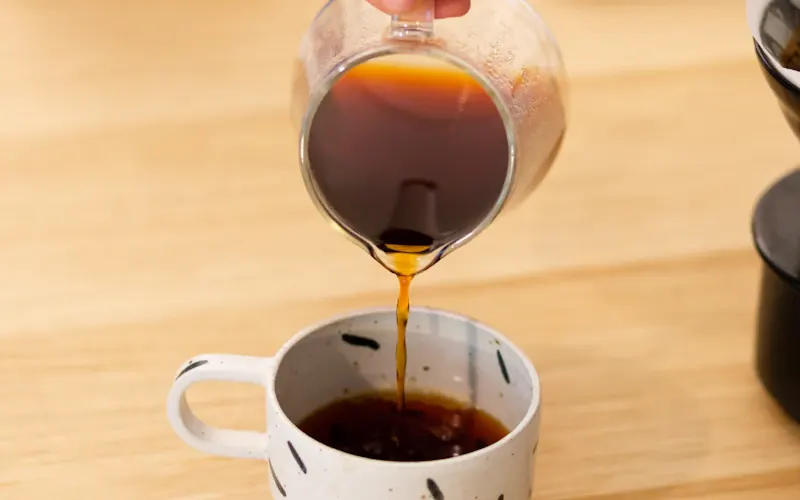
- The 60-degree cone, the spiral ribs and the single large outlet leave nothing to slow the water down mechanically: grind size and pouring set the flow, not the brewer itself.
- Bloom with roughly twice the coffee weight in water, 30 g for a 15 g dose, and give it 30 to 45 seconds, long enough for the bed to dome and start to settle back.
- Total brew time, bloom included, belongs between 2 min 30 s and 3 min 30 s. That number tells you whether to tighten or open the grinder for the next cup.
Beginner: the plastic V60 in size 02. Almost no thermal mass, so it takes no heat from the water and needs no preheating.
Advanced: the ceramic V60 in size 02. Heavier and demanding about preheating, but very stable in temperature once it is warm.
The V60 is a 60-degree cone, lined with spiral ribs, opened by a single large hole. Three features, and everything else follows from them. Nothing inside the brewer restricts the water on your behalf: flow comes out of the grind you chose and the way you pour. That is what makes the device demanding, and also what makes it readable, because every slip shows up in the brew time. This guide covers the object first, then the recipe and how to steer it, from rinsing the paper to the last gram of water.
Why does a 60 degree cone with one wide hole behave the way it does?
Ready to choose? → See our comparison and current prices
Hario started out in 1921 as a Japanese maker of heat-proof laboratory glass. The cone we use today came from a shelved conical dripper that the company's designers picked up again in 2004, working with resin makers and potters in Arita; it reached the market in October 2005. The name states the geometry: a V at 60 degrees. That angle gathers the grounds towards the centre, which lengthens the column of water and the contact time in the middle of the bed, where the cone is deepest.
The spiral ribs are not decoration. They hold the paper off the wall and leave a channel of air around the whole filter, so water can leave through the sides of the cone rather than only through the base. The single wide hole offers no resistance at all: unlike a base drilled with small openings, it regulates nothing. Flow is therefore set by three things only, how fine you ground, how many fines are blinding the paper, and the rhythm of your pouring.
In the cup that reads as clarity, drawn acidity and floral or fruit notes that stay separate. It is why the V60 suits expressive origins so well, Ethiopia, Rwanda, Kenya, Colombia. The trade-off is symmetrical: nothing here covers up an uneven grind, hard water or a careless pour.
Which pieces of kit does a V60 brew genuinely require?
- The cone: Hario makes three sizes, 01 for 1 to 2 cups, 02 for 1 to 4 cups, 03 up to 6 cups. The 02 covers nearly every home situation. Four materials coexist, plastic, glass, ceramic and metal including a copper version. Plastic has almost no thermal mass and needs no preheating; ceramic and glass need a real one, or they pull heat out of the brew during the bloom.
- Paper filters: they are size-specific. A 02 filter pushed into an 01 cone creases and lets water slip past the coffee. Bleached or unbleached both work; unbleached papers taste more of paper if you rinse them badly. Always rinse with hot water, then empty the rinse water before you dose.
- A gooseneck kettle: the narrow spout is what makes pour rate legible and repeatable. Hario's own V60 Buono range comes as stovetop, electric and copper versions, but any narrow-spout kettle does the job.
- A scale with a timer: 0.1 g resolution and a clock you can read without putting the kettle down. Without weight and time, a recipe cannot be repeated and a fault cannot be traced.
- A burr grinder: particle consistency is what sets brew time. A blade grinder makes far too many fines, blinds the paper and gives a different flow every morning.
Which numbers do you set, and what does each one buy you?
| Variable | Reference value | If you increase | If you decrease |
|---|---|---|---|
| Coffee-to-water ratio | 1:16 to 1:17 | Lighter, more acidic cup | More concentrated, denser cup |
| Grind size | Medium-fine, close to table salt | Faster drawdown, under-extraction | Slower drawdown, over-extraction |
| Water temperature | 92 to 96 °C | Faster extraction, deeper notes | Gentler extraction, sharper acidity |
| Bloom time | 30-45 seconds | Better saturation of coffee bed | Residual CO₂ disrupts extraction |
| Pour rate | 4-6 g/s | More turbulence, more aggressive | Gentler contact, softer extraction |
| Number of pours | 2-5 | More control, repeated agitation | Simpler, less turbulence |
What does the bloom actually vent, and how long does that take?
Roughly twice the coffee weight in water, so 30 g on a 15 g dose, and 30 to 45 seconds of waiting. Both figures are orders of magnitude rather than fixed values: coffee four days off the roaster degasses hard and happily takes a little more water and the full 45 seconds, while a bag opened three weeks ago has already given up most of its gas and is done in 30.
The mechanism is physical. Roasting leaves carbon dioxide trapped in the structure of the bean, and grinding releases part of it immediately. Hot water pushes the rest out at once: bubbles displace the water, the bed lifts, and pockets of gas form. While they are there, water travels around them instead of through the grounds, and extraction turns uneven. The bloom exists to vent that gas and wet the whole bed before the real pouring starts.
Two things to watch: the dome should rise and then begin to sink back, and no part of the surface should stay dry. Dry islands mean your bloom water is too little or badly distributed.
Which pouring pattern should you use, and why?
Concentric circles (most common)
After the bloom, pour water in steady concentric circles, moving from centre to edge and back, maintaining a roughly constant water level in the cone. The goal: never let the bed drop exposed (which creates uneven extraction) while avoiding pouring directly onto the paper filter edges (water bypasses the coffee). Pour continuously or in 50-60 g intervals.
Pulse pours
Bloom → pause → second pour → pause → third pour → etc. Each pause lets the level drop partially, creating different agitation at each stage. More control, more variables. Recommended once the circular technique is comfortable.
Concentrate plus bypass
Brew on a short ratio, somewhere around 1:10 to 1:12, then dilute in the cup with hot water held back for the purpose. The bed stays lightly loaded, flow is quick, and final strength is decided after the fact rather than during the brew. It is an advanced way to work: separating strength from extraction forgives a lot, but you need to know what you are aiming for.
How long should the whole brew take, from first drop to last?
On the reference recipe, 15 g to 250 g of water, the target is a brew that finishes draining between 2 min 30 s and 3 min 30 s, bloom included. It is not a grade to earn. It is the only measured feedback the brewer gives you, and it exists to decide the next setting.
- Well under target: water is passing without working the grounds. Tighten the grinder one step and repeat the same recipe before changing anything else.
- Well over target: the bed is holding water back. Open the grinder one step and pour a little more gently so fewer fines pack against the paper.
- Two brews in a row landing at different times: that is not the grind, it is the hand. Fix your pouring height and speed, then measure again.
Change one thing at a time or the measurement stops meaning anything. And keep the dose constant: brew times only compare at equal coffee weight.
Where do most V60 brews lose their quality?
- An unrinsed filter: paper in the cup and a cold cone at the start. Rinse with hot water, then empty the carafe before dosing.
- A rushed bloom: the gas comes out during the main pour instead and carves channels through the bed. Let the dome rise and settle.
- Water poured onto the edge of the paper: it slides between filter and wall without meeting the coffee. Stay a few millimetres inside the rim.
- A blade grinder: too many fines, a blinded paper, a different brew time every day. Burrs change everything here.
- Water at a rolling boil: above the 92 to 96 °C window bitterness takes over. Wait a minute after the kettle clicks, or set the temperature.
- No weighing at all: neither the dose nor the timing repeats, and coffee becomes a weekly lottery.
The V60 is an honest brewer. It does not flatter and it does not conceal. If your coffee is good and your water is clean, it will give you the most expressive cup you have ever tasted. If something in the chain is off, it will tell you clearly, every single time. That transparency is both its strength and its greatest teaching tool.
How do you adapt dose, temperature and bloom to the origin?
Starting points, not rules. The logic behind them is simple: the lighter and denser the bean, the hotter the water needed to open it, while a darker, more porous bean is happy at the bottom of the window.
- Ethiopia, jasmine, bergamot, floral: 15 g to 250 g, water at 95 °C, medium grind. Long bloom, 45 seconds. Gentle spiral pours so the aromatics are not drowned.
- Rwanda or Burundi, blackcurrant, fruity: 15 g to 240 g, water at 94 °C. Bloom for 30 seconds, then two pours of 105 g.
- Colombia, caramel, hazelnut, apple: 15 g to 250 g, water at 93 °C. Bloom for 30 seconds, then continuous concentric circles.
- Sumatra or Indonesia, earthy, cocoa: 15 g to 240 g, water at 92 °C, one step coarser. Bloom for 45 seconds, then a single continuous pour.
Our picks
The V60 was not a lucky shape. Hario returned to an abandoned conical dripper in 2004 and worked the design out with resin makers and Arita potters before releasing it in October 2005; the goal was to get close to the taste of cloth-filtered coffee using a paper cone. The 60-degree angle, the ribs that keep the paper off the wall, the one wide hole, each detail answers a specific problem. The ceramic V60 in size 02 is the safe buy: an inert material, very steady temperature once preheated, and filters available everywhere. The plastic version of the same cone costs far less and forgives you for skipping the preheat. Pair either with a scale that reads to 0.1 g and runs a timer, such as the Timemore Black Mirror Basic, and the recipe becomes repeatable.
View Hario V60 on Amazon →Which V60 gear should you choose for your level and use?
* These links may generate a commission if you make a purchase, at no extra cost to you. Learn more.
Affiliate links: as an Amazon Associate, expertcafe.be earns from qualifying purchases at no extra cost to you. Learn more.