☕ Key takeaways
- Ethiopia is the genetic birthplace of Arabica: unselected heirloom varieties grown in forest gardens offer an aromatic diversity unmatched by any other single origin.
- Yirgacheffe is the world benchmark for floral, citrusy coffees (jasmine, bergamot, lemon); Sidamo and Guji produce more complex, fruity profiles with great depth.
- Processing method radically changes the profile of the same Ethiopian coffee: natural amplifies fermented fruit character; washed reveals pure florality and clean acidity.
Ethiopian Coffee Guide: Yirgacheffe, Sidamo, Harrar, Guji
3 key takeaways
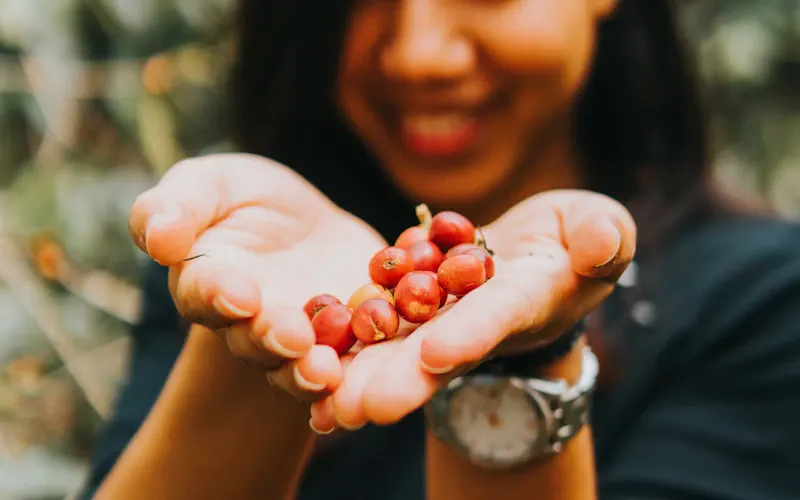
- If you've ever sipped a coffee and thought you smelled jasmine, blueberry, or bergamot, chances are it was Ethiopian. Ethiopia is the birthplace of Coffea arabica, and the…
- The single most important decision when buying Ethiopian coffee is understanding the process. Washed (wet-processed) coffees are defined by clarity, brightness, and delicacy. They…
- Belgian specialty roasters bring in Ethiopian micro-lots sourced through specialty importers or direct trade relationships. La Baie Coffee (Waterloo) and Naga Coffee (Rixensart) are reference specialty coffee venues in Brabant Wallon.
If you've ever sipped a coffee and thought you smelled jasmine, blueberry, or bergamot, chances are it was Ethiopian. Ethiopia is the birthplace of Coffea arabica, and the country has never really stopped being surprised by what its land can produce. With roughly 15 million people involved in coffee growing, and a landscape of highlands, forests and terraced farms stretching across the south and east of the country, Ethiopia offers a diversity of flavour that no other single origin can match. This guide is for curious discoverers: people who want to understand what they're tasting, why it tastes that way, and how to keep finding more of it. We'll explore four key regions, Yirgacheffe, Sidamo, Harrar, and Guji, each with its own personality, process, and story.
- Birthplace of arabica coffee, wild and cultivated varieties grow nowhere else like this.
- Four main regions: Yirgacheffe (floral, citrus), Sidamo (sweet, peachy), Harrar (wild, winey), Guji (complex, tropical).
- Two key processes: washed (clarity and brightness) vs natural (fruit density and sweetness).
- Altitudes between 1,700 and 2,400 m, among the highest in global coffee production.
Why does Ethiopian coffee taste unlike any other origin?
The answer is genetic. Most coffee-growing countries rely on a handful of known, catalogued varieties, Bourbon, Caturra, Catuaí. In Ethiopia, the picture is completely different. The forests of Kaffa, Bench Maji and Sheka contain hundreds of wild genotypes that scientists at the Ethiopian Biodiversity Institute estimate at over 10,000 distinct accessions. On cultivated land, farmers grow what are called "heirloom" or "indigenous" varieties, mixed populations selected over generations by eye and experience, not by laboratory breeding.
What this means in the cup is remarkable unpredictability of the best kind. Two Yirgacheffe washed coffees from neighbouring washing stations can taste so different that a first-time taster would never guess they share a region. This is terroir in its most raw and honest form: the plant doing what it does in the soil and climate it was born into, with minimal human interference. The Jimma Agricultural Research Center identified and propagated two specific lines, 74110 and 74112, in the 1970s for disease resistance and cup quality, and these are now widely planted. But much of what makes Ethiopian coffee extraordinary remains genetically unmapped.
What makes Yirgacheffe the world's floral benchmark?
Altitude, soil and a meticulous washed process, in that order. Yirgacheffe sits within the broader Sidama region in southern Ethiopia, at altitudes between 1,800 and 2,200 metres. Around 200,000 smallholder farmers cultivate coffee on plots of 1-2 hectares each, delivering cherries to centralised washing stations that define the quality and character of each lot. The soil is a red-brown laterite clay, slightly acidic and well-drained, ideal conditions for slow cherry development and aromatic complexity.
A washed Yirgacheffe is defined by clarity: jasmine, bergamot, lime zest, Earl Grey tea, orange blossom. The fermentation process, cherries depulped, then fermented for 12 to 72 hours in stone tanks before being washed clean and dried on raised African beds for 10 to 15 days, removes the cherry pulp and mucilage completely, letting the intrinsic flavours of the bean shine without interference. Natural Yirgacheffe coffees, increasingly common since around 2015, add layers of strawberry, blueberry and raspberry on top of that floral base.
The sub-zones of Kochere, Gedeo, Wenago and Chelchele each have their own micro-terroir. A Kochere and a Gedeo from the same season can have perceptibly different profiles. This granularity is what draws specialty roasters to Ethiopia repeatedly, year after year.
How did Sidamo win the right to its own name?
Through trademark law, in a landmark dispute that ran from 2005 to 2007. Ethiopia's government attempted to register Sidamo (along with Yirgacheffe and Harrar) as trademarked names with the US Patent and Trademark Office, directly challenging Starbucks, which had applied for those names itself. Ethiopia ultimately succeeded in securing licensing agreements that guaranteed royalty flows back to producers. It was a rare and significant victory for coffee-growing communities in global trade politics.
The Sidama region (internationally known for years as "Sidamo") covers a broader area than Yirgacheffe, with altitudes ranging from 1,500 to 2,400 metres and a greater diversity of soil types and micro-climates. Sidamo washed coffees tend to be a step rounder than Yirgacheffe: peach, apricot, nectarine, with a softer acidity and a medium to full body that makes them particularly appealing to people discovering specialty coffee for the first time.
Within Sidamo, the sub-zone of Bensa has emerged since 2018 as one of the most exciting addresses in Ethiopian coffee. At altitudes reaching 2,300-2,400 metres, Bensa micro-lots offer a complexity that rivals the best Yirgacheffe, with a slightly fuller body and longer finish.
What makes Harrar the wildest coffee in Ethiopia?
Dry ground, whole-cherry drying and almost no standardisation. Harrar is a different world. Located in the eastern highlands of Ethiopia, near the ancient walled city of the same name, the coffee grows at 1,700-2,100 metres in a semi-arid climate with no irrigation. Almost all Harrar coffee is processed as natural, entire cherries dried whole in the sun for three to six weeks, on rooftops, on clay terraces, on the ground. The fermentation that happens during this long drying period is what gives Harrar its distinctive signature: blueberry, wild berry, prune, dark chocolate, leather, and occasionally a winey funkiness that divides opinions but never goes unnoticed.
Historically, Harrar is the direct ancestor of the "Mocha" coffees that were traded through the Yemeni port of the same name, and later blended with Java to create the classic "Moka-Java" blend that defined European coffee taste in the 17th and 18th centuries. Local varieties are known as "longberry" and "shortberry," reflecting two distinct genotypes that produce slightly different cup profiles. Production remains highly fragmented and artisanal: small farmers drying their coffee on their own terraces, with very little standardisation. This makes quality inconsistent but also keeps the character wild in a way that no amount of controlled processing can replicate.
Why did Guji become a region in its own right?
For years, coffee from the Guji zone in southern Ethiopia was lumped in with Sidamo on export documentation. Specialty roasters started pushing back around 2015-2018, demanding that Guji be recognised independently, and the market agreed once it tasted what Guji could produce on its own terms. The sub-zones of Shakiso, Uraga, and Hambela Wamena grow coffee at 1,900-2,350 metres, producing cups that feel like a synthesis of Yirgacheffe's precision and Sidamo's warmth: passion fruit, guava, lychee, hibiscus, sometimes rose.
The Halo Beriti washing station in Hambela has become one of the world's most sought-after addresses for natural lots, regularly fetching prices above $22/kg on the specialty market. The story of Guji is also the story of a wider truth about Ethiopian coffee: the map is still being drawn. Regions like Borena, Bench Maji, and Kaffa itself are beginning to appear on specialty radar, each with distinct profiles and histories that the market is only starting to understand.
Should you choose a natural or a washed Ethiopian coffee?
The single most important decision when buying Ethiopian coffee is understanding the process. Washed (wet-processed) coffees are defined by clarity, brightness, and delicacy. They suit filter methods, pour-over, Chemex, AeroPress, at 92-94°C, ratio around 1:16. Natural (dry-processed) coffees bring fruit density, sweetness, and body. They work beautifully in espresso or full-immersion methods like the French press or Clever Dripper at 91-93°C. Honey-processed Ethiopian coffees, increasingly common since 2020, sit between the two, mucilage partially retained during drying, creating a hybrid that's worth exploring if you enjoy both styles.
How do Yirgacheffe, Sidamo, Harrar and Guji compare?
| Region | Altitude (m) | Dominant process | Cup profile | Body | Acidity |
|---|---|---|---|---|---|
| Yirgacheffe | 1,800-2,200 | Washed, Natural | Jasmine, bergamot, lime | Light | Bright, vivid |
| Sidamo / Sidama | 1,500-2,400 | Washed, Natural | Peach, apricot, citrus | Medium | Soft to bright |
| Harrar | 1,700-2,100 | Natural | Blueberry, wine, dark chocolate | Full | Low, winey |
| Guji | 1,900-2,350 | Washed, Natural | Passion fruit, guava, hibiscus | Medium | Intense, phosphatic |
How do you find great Ethiopian coffee in Belgium?
Traceability is everything. Look for bags that name the region and ideally the washing station (Kochere, Halo Beriti, Bensa), the process (washed or natural), and the roast date. Avoid anything labelled simply "Mocha d'Éthiopie", that usually means an undifferentiated commodity blend with no meaningful flavour identity.
Belgian specialty roasters bring in Ethiopian micro-lots sourced through specialty importers or direct trade relationships. Specialty coffee fairs and roastery events are excellent places to taste Ethiopian coffees side by side and develop your own regional preferences.
"Ethiopian coffee is the only origin where I still feel genuinely surprised. Every new Guji natural, every Yirgacheffe washed from a washing station I haven't encountered before, there's always something in the cup I didn't predict. That unpredictability isn't a flaw. It's the point." Lorenzo, specialty coffee curator, expertcafe.be