☕ Key takeaways
- Home espresso machines fall into 4 families: lever (manual pressure control), semi-automatic (most common, pump + thermostat), automatic (integrated grinder), dual boiler (maximum stability).
- The boiler system is the key technical criterion: thermoblock (fast, temperature compromise), single boiler (stable but slow to switch coffee→steam), dual boiler or E61 (maximum stability, higher cost).
- A PID (degree-accurate temperature controller) is the most impactful upgrade on an entry-level semi-auto machine: it transforms an unstable brewer into a precision tool.
Espresso Machine Guide: Lever, Semi-Auto, Automatic, Dual Boiler
3 key takeaways
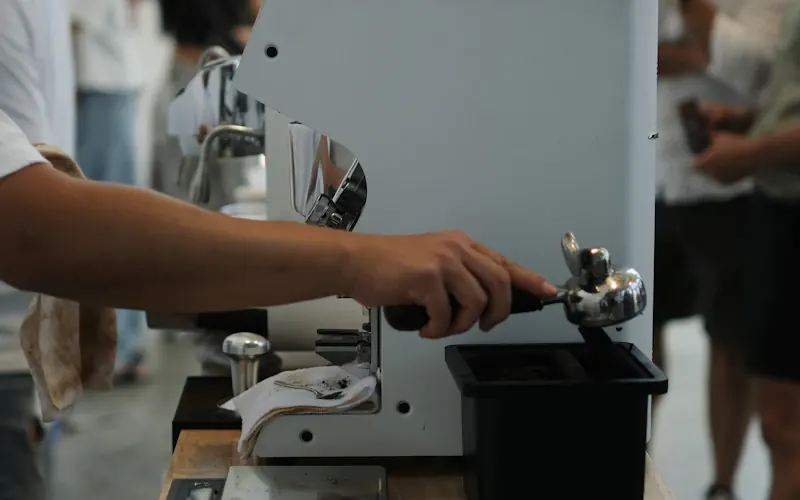
- A lever machine works without a pump, on a pressure curve that rises then falls. That curve is exactly what pressure profiling tries to recreate electronically.
- Price buys repeatability rather than flavour: the same recipe pulled first and fifth in a row holds on an expensive machine and drifts on a cheap one.
- An adjustable burr grinder moves the cup further than the step from single boiler to dual boiler. Fund that part first.
Choosing an espresso machine, from semi-auto to dual boiler, starts with the hardware.
Beginner: Sage Bambino Plus (~€400), 3s heat-up, PID, compact
Advanced: Sage Barista Express Impress (~€650), built-in grinder, all-in-one
Walking into the espresso machine market for the first time can feel overwhelming. Prices range from a hundred euros to several thousand. Terms like "PID", "dual boiler", "HX" and "pressure profiling" appear everywhere but are rarely explained clearly. This guide cuts through the noise: four types of machines, the boiler technology that drives them, what each means for your daily experience, and which machines are worth the money at each price level.
Which four architectures do home espresso machines fall into?
Start at the lever and finish at the dual boiler and you have crossed the entire domestic range. Every step along the way hands a little manual involvement back to the machine, and asks a little more of the wallet in return.
Ready to choose? → See our comparison and current prices
Lever machines
Lever machines are the original espresso makers, dating back to the Gaggia and La Pavoni machines of the 1940s. You pull a lever that either compresses a spring (spring lever) or directly applies manual pressure (direct lever). The pressure profile is not a fixed 9 bars, it rises and falls in a natural curve. This variable pressure is something modern machines try to replicate artificially through "pressure profiling" features.
Who are lever machines for? Coffee enthusiasts who want a tactile, meditative ritual and complete control over pressure. They require patience and practice, produce one shot at a time, and are mechanically very simple, which makes them incredibly durable. Notable examples: La Pavoni Europiccola, Flair PRO 2, Cafelat Robot.
Semi-automatic machines
The semi-automatic is the workhorse of serious home espresso. You choose the coffee, grind it, dose it, tamp it, and start the extraction manually. The machine handles pressure and temperature. You stop the shot by hand (pure semi-auto) or the machine stops it automatically by volume or weight. This is the machine type that gives you the most control without the physical demands of a lever. Notable brands: Rancilio (Silvia Pro X), Breville/Sage (Barista Express, Bambino Plus), ECM (Classika PID, a single boiler built around an E61 group), Lelit (Mara X).
Automatic and super-automatic machines
Automatic machines grind, dose, tamp, brew and eject the puck automatically. You fill the bean hopper and water tank; the machine handles everything else. The trade-off is control: you cannot adjust the grind as precisely, the extraction parameters are pre-set, and the results, while often quite good, rarely match a well-tuned semi-auto. Super-automatics are the right choice for households where multiple people want coffee quickly without learning technique. Notable brands: De'Longhi (Magnifica Evo, PrimaDonna), Jura (E6, Z10), Philips (3000-5000 series).
Dual boiler machines
A dual boiler machine has two separate heating elements: one kept at brew temperature (around 93 °C) and one kept at steam temperature (130-140 °C). This means you can pull a shot and steam milk at the same time, without any thermal instability between the two. Dual boilers are the reference standard for serious home baristas and light commercial use. Notable brands: Breville/Sage (Dual Boiler), ECM (Synchronika), Lelit (Bianca V3), Rocket Espresso (R58).
How does each heating system hold brew temperature?
Almost nothing in an espresso machine matters more than what happens to the water between the tank and the group head. The table below sets out the four ways manufacturers have solved that, and where each one gives ground.
| Boiler type | How it works | Advantage | Limitation | Found on |
|---|---|---|---|---|
| Single boiler | One element for both extraction and steam | Simple, compact, affordable | Cannot steam and brew simultaneously; thermal instability | Rancilio Silvia, La Pavoni |
| Thermoblock / Thermocoil | Water heats on demand through a coil | Very fast heat-up (30-60 s), compact | Less thermal mass, less stability | Breville Bambino, De'Longhi Dedica |
| Heat exchanger (HX) | Brew water passes through a tube inside the steam boiler | Simultaneous steam and brewing, mid-range price | Requires a "flush" to stabilise brew temperature | Lelit Mara X, Rocket Appartamento |
| Dual boiler | Two independent elements (brew + steam) | Maximum thermal stability, perfect simultaneity | Large footprint, high cost | Breville Dual Boiler, ECM Synchronika |
What do you actually gain as the price bracket rises?
What separates a €400 machine from a €2,500 one is rarely the best shot each can pull on a good morning. It is how often that shot comes back. Indicative European street prices, checked September 2026.
| Model | Type | Boiler | Price | PID | Best for |
|---|---|---|---|---|---|
| Breville Bambino Plus | Semi-auto | Thermojet (3 s) | €380 to €450 | Yes | Serious beginner, small kitchen |
| Rancilio Silvia Pro X | Semi-auto | Dual boiler | €1,300 to €1,600 | Yes (dual PID) | Intermediate enthusiast, Italian durability |
| Lelit Mara X | Semi-auto HX | Heat exchanger | €1,100 to €1,300 | Yes | Latte drinkers, continuous flow |
| Breville Dual Boiler | Dual boiler | Dual boiler | €1,150 to €1,400 | Yes (dual PID) | Enthusiast, pressure profiling entry |
| Lelit Bianca V3 | Dual boiler + flow control | Dual boiler | €2,200 to €2,500 | Yes | Pressure profiling enthusiast |
| ECM Synchronika | Dual boiler | Dual boiler | €2,400 to €2,700 | Yes | Connoisseur, made in Germany, decades of use |
Why does a PID change the way a machine behaves?
Three letters, Proportional, Integral and Derivative, describe how the controller reacts to the gap between measured and target temperature. A machine without one heats in on/off cycles: the element runs until the set point is reached, cuts out, and the boiler drifts several degrees either side. A PID modulates instead of switching, holding the swing to roughly a degree. That matters because a shift of 2 °C is enough to move a shot from balanced to sour or bitter. Most machines above the €400 mark now ship with a PID or an equivalent temperature management board.
Which machine type fits your daily routine?
- Budget under €500: Breville Bambino Plus. PID, three-second heat-up, compact. Spend the rest of your budget on a good grinder.
- Serious enthusiast (€1,000 to €1,600): Rancilio Silvia Pro X, a dual boiler built to be serviced for years, or the heat exchanger Lelit Mara X if milk drinks dominate.
- Flow control territory (€1,000 to €2,500): Breville Dual Boiler for value, Lelit Bianca for pressure profiling. These are machines you will use for 10+ years.
- No-compromise connoisseur (above €2,500): ECM Synchronika, Rocket Espresso R58, La Marzocco Linea Mini. Investment-grade equipment built to last decades.
- Convenience above all: De'Longhi Magnifica or Jura E6. Maximum comfort, minimum technique.
Where does the machine stop influencing the cup?
Even the most expensive espresso machine will not save a poor grind, stale coffee or chalky water. The machine is the environment; what happens inside the portafilter is a matter of grinder, coffee freshness and technique. Spending €2,000 on a machine with a blade grinder is a mistake. The reverse, a modest machine with a quality burr grinder, is often the wiser choice for beginners.
The espresso machine is the most visible piece of equipment, but rarely the most decisive. A quality grinder, fresh coffee and balanced water, that is where the shot is made or lost. The machine just needs to stay out of the way.
Our picks
Here's a fact that surprises most buyers: the Sage Barista Express Impress sold in Europe is the same machine as the Breville Barista Express Impress sold in the US and Australia, same internals, same PID, same integrated conical burr grinder, just a different badge for different markets. It sits in the €650 to €750 bracket in Europe as of September 2026. If counter space is the constraint, the Breville Bambino Plus (sold as Sage in Europe) reaches brew temperature in about three seconds and delivers PID control in a chassis under 20 cm wide, without the mass of a full prosumer machine.
View espresso machines on Amazon →Quick comparison
* These links may generate a commission if you make a purchase, at no extra cost to you. Learn more.
Affiliate links: as an Amazon Associate, expertcafe.be earns from qualifying purchases at no extra cost to you. Learn more.