☕ Key takeaways
- The four enemies of fresh coffee are oxygen (oxidation), UV light, moisture and heat, an opaque bag with a one-way valve protects against three of the four.
- The refrigerator myth persists: condensation from temperature cycling degrades coffee faster than room-temperature storage in a proper airtight container.
- The freezer is the only valid exception for long-term storage (more than 2 weeks): freeze in airtight single-use portions and never refreeze thawed coffee.
Coffee Storage Guide: Oxygen, Light, Humidity, Refrigerator, Myths
3 key takeaways
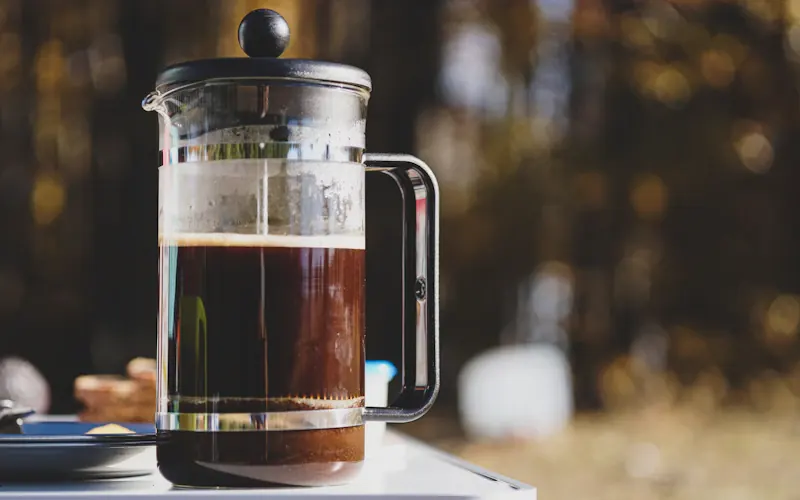
- A specialty coffee stored badly loses most of its aromatic complexity in under a week, while the same coffee stored properly stays expressive for a month.
- Oxygen is the dominant factor: cutting residual oxygen in a container to 0.5% multiplies coffee shelf life twentyfold (Labuza et al., 2001).
- The roast date on the packaging, not the purchase date, is the starting point for every freshness window.
A specialty coffee bought from a great roaster can lose most of its aromatic complexity in under a week if stored badly, or stay expressive for a month with the right approach. Storage isn't a minor detail: it's the continuation of the work the farmer and roaster put into that coffee. This guide dismantles the myths (refrigerator, supermarket bags, clear glass jars on the counter) and gives you the rules that actually work.
Why does oxygen make roasted coffee go stale?
Because roasted coffee stays chemically active long after it leaves the roaster. Its surface lipids, the oils that give body and aroma, oxidise in contact with atmospheric oxygen through a rancidity process similar to what happens to olive oil. Volatile aromatic compounds also react with O₂ and break down into less pleasant by-products.
That degradation speeds up with temperature and with exposed surface area. Grinding multiplies that surface, which accelerates both degassing and rancidity, and makes ground coffee far more temperature-sensitive: Labuza et al. (2001) measured a temperature coefficient Q10 of about 1.5 for degassing whole beans and roughly double that for ground coffee. Grinding just before brewing isn't coffee snobbery.
Two moves limit oxidation: get the air out of the container (vacuum sealing, or a one-way valve that lets CO₂ out without letting O₂ in), and open it less often. The stakes are quantified. The Specialty Coffee Association's literature review on coffee staling (Emma Sage, 2012) reports that cutting residual oxygen to 0.5% inside a container multiplies shelf life twentyfold (Labuza et al., 2001), and that each additional percentage point of oxygen raises the degradation rate by around 10% (Cardelli and Labuza, 2001).
Does light really damage coffee stored in a clear glass jar?
Yes, though the effect is far less documented than oxygen. The major reviews of coffee staling put oxygen, moisture and temperature front and centre and assign light no measured coefficient. Photodegradation is still a recognised mechanism: in the presence of oxygen, photons sustain surface photo-oxidation, and the National Coffee Association recommends opaque containers explicitly for that reason. A clear jar on a sunny counter fails twice over: it filters nothing, and it warms up.
The fix is cheap: opaque containers (ceramic, stainless steel, tinted glass, kraft bags with an aluminium inner lining). If you like the look of a glass jar, keep it inside a closed cupboard or wrap it in an opaque cloth.
How does ambient moisture speed up aroma loss?
Roasted coffee is hygroscopic: it pulls moisture out of the air around it. This is not a food safety question, roasted coffee is a shelf-stable product that does not spoil through microbial or enzymatic processes. It is an aroma question. Absorbed water raises the bean's water activity, which accelerates the escape of volatile compounds and the oxidation of lipids, two mechanisms the literature ties directly to a shorter shelf life. Coffee left in a bathroom, above a steam wand or in a poorly ventilated kitchen turns dull, loses brightness in the cup and develops papery, musty notes.
Keep coffee away from steam sources. Never dip a wet spoon or a damp measuring scoop into the bag or jar.
How much faster does coffee stale when it is stored warm?
Less than the usual shorthand suggests. In general chemistry, the van 't Hoff rule holds that a 10°C rise roughly doubles reaction rates. Measured on coffee, the figure is more modest: Labuza et al. (2001) report a Q10 of about 1.5 for degassing whole beans, so half again as fast per 10°C, and roughly double that for ground coffee. The practical order of magnitude still holds, a cupboard at 30°C wears a coffee down noticeably faster than a cupboard at 20°C. The kitchen is often the warmest room in the house, with spikes during cooking. Aim for 15 to 20°C at a stable temperature. The spot on or next to an espresso machine is the worst of all, radiant heat from the boiler creates a hostile microenvironment.
Should you keep coffee in the fridge?
No, not for everyday use. The idea is tempting: cold slows chemical reactions, so coffee should last longer. True in theory, wrong in practice, for two decisive reasons.
First, the refrigerator is an aroma-rich environment (cheese, cooked food, vegetables). Coffee, being highly hygroscopic and porous, absorbs these odours within hours. The result: foreign flavour notes in the cup that mask and distort the coffee's original character.
Second, condensation. Every time you take the coffee out of the fridge, it moves from a cold environment into warmer, more humid air. Moisture condenses on the beans or grounds, exactly the mechanism described above. Open the bag several times a week and you are regularly putting liquid water back into the coffee. The payoff is nil anyway: the National Coffee Association credits refrigerated beans with about 2 weeks of freshness, against 1 to 3 weeks at room temperature in an opaque airtight container.
The refrigerator is one of the worst places to store coffee for everyday use. It gives the impression of doing the right thing while accelerating aromatic degradation through odour absorption and repeated condensation.
Does freezing coffee actually preserve its aroma?
Yes, provided you follow a strict protocol. At −18°C chemical reactions are not stopped, they are strongly slowed. The clearest published work comes from Penn State: Cotter and Hopfer (Beverages, 2018) compared nine weeks of freezer storage against room-temperature storage, and their panel of 48 coffee consumers judged the aroma of the frozen beans closer to freshly roasted coffee, with the gap widest on dark roasts. One honest caveat belongs here: the Specialty Coffee Association's review notes that while most studies on cold storage do find slower staling, none isolated the effect of the temperature swings involved in taking coffee in and out. Hence the protocol.
- Portion before freezing: divide the coffee into one-week doses (e.g. 250 g split into four 60-65 g bags). Each bag is taken out of the freezer only once.
- Airtight packaging: double-zip bags with maximum air removal, or vacuum-sealed bags. Residual air is a problem even at low temperatures.
- Single defrost only: never refreeze defrosted coffee. Refreezing creates damaging condensation/evaporation cycles.
- Full defrost before opening: let the sealed bag return to room temperature (30-60 minutes) before opening. This prevents condensation on the beans.
Which container blocks oxygen, light and moisture best?
An opaque airtight canister, stainless steel or sealed ceramic, kept out of the light, covers all three risks at once. A vacuum canister does better still on oxygen. The clear jar left out on display is the only common option that fails outright on one criterion.
| Container | O₂ protection | Light protection | Humidity protection | Recommendation |
|---|---|---|---|---|
| Roaster bag with valve | Good (one-way valve) | Good (kraft + foil) | Good (sealed) | Ideal as long as sealed correctly after opening |
| Clear glass jar | Medium (rubber seal) | None | Good | Must be kept inside a closed cupboard |
| Stainless steel airtight canister | Good | Excellent | Good | Recommended for daily use |
| Ceramic canister with seal | Good | Excellent | Good | Good option, check seal quality |
| Vacuum canister (Airscape, Fellow Atmos) | Excellent | Variable (by model) | Excellent | Best choice for optimal preservation |
| Simple zip-lock plastic bag | Poor | Variable | Poor | Short-term emergency use only |
| Refrigerator (any container) | Variable | Good (closed) | Poor (condensation) | Not recommended for daily use |
How long does a bag of coffee keep its roast profile?
Days for ground coffee, weeks for whole beans. These windows assume the storage conditions described above (opaque, airtight, stable room temperature). They mark the point where coffee still expresses its roast profile satisfactorily, not the food safety limit, which is far longer.
- Filter coffee, whole bean: optimal 7-21 days post-roast. Acceptable to 45 days for non-demanding daily use.
- Espresso, whole bean: optimal 10-30 days post-roast. Acceptable to 60 days.
- Filter coffee, ground: 2-5 days maximum after grinding in optimal conditions.
- Espresso, ground: 24-48 hours after grinding. Ideally: grind just before extraction.
- Frozen coffee, whole bean (strict protocol): 3 to 6 months in sealed single-use portions.
These figures line up with the National Coffee Association's own numbers for whole beans, 1 to 3 weeks at room temperature and 3 to 4 months in the freezer. They are stricter for ground coffee: the NCA quotes 1 to 2 weeks of residual freshness where we quote a few days of optimal expression. The gap is a difference in standards, not a disagreement about the chemistry.
The roast date on the packaging is the starting point for all these windows, not the purchase date, which may fall weeks or months after roasting with some distributors.
What does the published research on freezing coffee really show?
Freezing generates more argument in the specialty community than almost any other storage question, and part of the reason is that the two camps are describing different practices. The published evidence supports freezing under controlled conditions. Casual freezing, the kind most households actually attempt, is a different thing entirely.
Start with what has been measured. Cotter and Hopfer (Beverages, 2018) stored roasted arabica for nine weeks, half in a freezer and half at room temperature, then ran both headspace gas chromatography and a sensory panel of 48 coffee consumers. Frozen beans held their aroma closer to a freshly roasted control, and the effect was clearest on dark roasts; light roasts lost comparatively little aroma either way. Their supervisor made a point worth repeating: searching the literature, the team found no published evidence for the condensation objection that dominates online debate. The Specialty Coffee Association's own staling review reaches a compatible conclusion, most cold-storage studies find slower staling, but none of them separated out the effect of temperature swings.
So the condensation risk is a practical argument rather than a measured one, and it is easy to design out. The method is to avoid ever exposing cold coffee to warm air. Portion the coffee before freezing, into small airtight containers or vacuum-sealed bags. The strictest version goes down to a single brew, 15 to 25 grams, ground and used in one session. The workable everyday version is the week's dose described earlier in this guide, taken out once and never returned. Either way, let the sealed container come back to room temperature, 30 to 60 minutes, before you open it. The coffee never meets warm humid air while it is cold, so there is nothing for moisture to condense onto.
Where does that leave the everyday drinker? For rare or expensive coffee, competition lots, small natural-process releases, single-dose freezing is a genuine preservation strategy. For a bag you will finish in three or four weeks, the overhead outweighs the benefit, and buying smaller quantities more often gets you the same result with less fuss.
Which storage habits actually slow oxidation at home?
Four habits do most of the work: squeeze the air out, open the container less, keep it dark, and keep it cool. Oxygen is the primary chemical agent of coffee staling, and how fast a coffee stales tracks how well your container and your routine limit its contact with air.
One-way valve bags, the standard specialty packaging, are excellent as long as they stay sealed, and they remain a reasonable everyday container for a couple of weeks after opening if you press the air out and reseal tightly each time. The valve lets residual CO₂ escape without letting oxygen in. Its weakness is you: every opening, scooping and resealing cycle admits fresh air, and that exposure accumulates.
Airtight canisters designed for coffee are the next step up. The Fellow Atmos uses a vacuum pump mechanism to pull air out each time the canister is closed; the Airscape uses an inner plunger that presses down onto the coffee and expels the headspace air. Both reduce residual oxygen meaningfully, though neither reaches the exclusion of professional nitrogen-flushed packaging, which the literature credits with roughly doubling shelf life against unflushed bags (Alves et al., 2001).
Opaque beats transparent. Photo-oxidation is a real mechanism, and while it has no measured coefficient in the coffee staling literature, the practical recommendation is unanimous, including from the National Coffee Association: store coffee in opaque containers. A clear canister on a bright counter is worse than the same canister in a cupboard. If you keep a glass jar for the look of it, put it behind a door.
Temperature deserves more attention than most guides give it, and less drama than some give it. The rule of thumb that reaction rates double every 10 °C is general chemistry, not a coffee measurement. On coffee, Labuza et al. (2001) measured a Q10 near 1.5 for degassing whole beans, roughly double that once ground. A canister on a 22 °C counter therefore ages faster than the same canister in a 12 °C pantry, just not twice as fast. None of this is an argument for the fridge, which brings back moisture and food odours. It is an argument for the coolest, darkest, driest cupboard you have.