☕ Key takeaways
- The Chemex uses thick bonded paper filters, which the maker specifies as 20 to 30% thicker than most competing papers. They hold back oils and fine particles and give a cup of unusual clarity.
- Reference parameters: 60 g coffee per litre of water, 92 to 94 °C, coarse grind, total brew time of 3 min 30 s to 4 min 30 s with a 45-second bloom.
- The Chemex particularly flatters floral and fruity coffees (Ethiopia, Kenya): its pure filtration reveals delicate aromatic complexity but can flatten bolder, heavier coffees.
Chemex Brew Guide: Pure Filtration, Floral Coffee, Iconic Glass
3 key takeaways
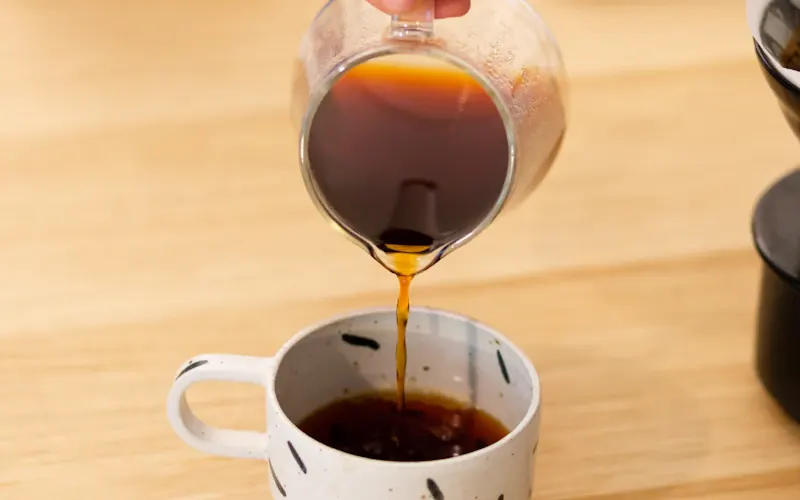
- Invented in 1941 by chemist Peter Schlumbohm, the Chemex sits in the permanent collection of the Museum of Modern Art in New York, a distinction few kitchen objects ever earn.
- Chemex sells its bonded papers in square, circle and half-moon shapes, bleached white or unbleached natural, and specifies them as 20 to 30% thicker than most competing filters, and that thickness sets off a chain of effects in the cup.
- The Chemex is the method of choice for coffees with floral, fruity, and bright profiles: Ethiopian washed (Yirgacheffe, Sidama), Colombian Nariño, Kenyan AA. These origins express an aromatic range through the Chemex that espresso concentrates too much and French press muddies with excess body.
Beginner: Chemex Classic 3-cup, borosilicate glass, 0.45 litres, right for one or two people
Advanced: Chemex Classic 6-cup, borosilicate glass, 0.9 litres, the 700 g recipe fits comfortably
Invented in 1941 by chemist Peter Schlumbohm, the Chemex sits in the permanent collection of the Museum of Modern Art in New York, a distinction few kitchen objects ever earn. Its hourglass silhouette, borrowed from laboratory glassware, its wood collar and its borosilicate body have made it a design icon, but behind the beauty lies a precise brewing logic. The Chemex paper filter, noticeably thicker than a standard drip filter, traps oils, fine particles, and part of the bitter-tasting fraction, delivering a cup of unusual clarity. If you have ever wondered what a "transparent" cup of coffee tastes like, where every aromatic note is distinct and origin character reads clearly, the Chemex is the answer.

What does the Chemex filter hold back that thinner papers let through?
Ready to choose? → See our comparison and current prices
Chemex sells its bonded papers in square, circle and half-moon shapes, bleached white or unbleached natural, and specifies them as 20 to 30% thicker than most competing filters. That thickness sets off a chain of effects in your cup:
- Oil retention: the diterpenes carried in coffee oils, cafestol and kahweol, are very largely trapped by paper of this kind. Without those compounds, which supply body and richness, the Chemex produces a light, crystalline brew.
- Fines filtration: fine particles that slip through other filters are captured, so the cup arrives free of haze and free of sediment.
- Slowed flow rate: the denser paper slows water passage, which extends contact time and partly offsets the body lost with the oils.
Specialty coffee roasters often use the Chemex as an evaluation tool: its transparency means every quality, and every flaw, of the coffee shows up clearly in the cup.
What dose, water and grind does a 700 g Chemex batch need?
| Parameter | Recommended value | Impact |
|---|---|---|
| Coffee dose | 42 g (for 700 g water) | Body, concentration |
| Water-to-coffee ratio | 1:16 to 1:17 | Lightness vs. intensity |
| Water temperature | 92-94 °C | Extraction, aromatic profile |
| Grind size | Coarse (sea salt) | Flow rate, clarity, no bitterness |
| Bloom | 80 g water, 45 s | Degassing, evenness |
| Total brew time | 3 min 30 s to 4 min 30 s | Development, depth |
How do you sequence the bloom and the three pours in a Chemex?
- Rinse the filter: place the filter (triple-fold side facing the spout) in the Chemex. Rinse generously with hot water to eliminate paper taste and preheat the glass. Discard rinse water.
- Dose and grind: 42 g of coffee, coarse grind (slightly finer than French press). A quality burr grinder is essential for a homogeneous grind at this calibre.
- Bloom (pre-infusion): pour 80 g of water at 93 °C over the dry coffee, saturating all the grounds. Wait 45 seconds. The coffee will swell and bloom dramatically, the fresher the coffee, the more spectacular the bloom.
- First pour: pour gently up to 300 g in slow, concentric circles from the centre outward. Avoid touching the filter walls. Let the level drop to around 150 g remaining in the filter.
- Second pour: pour up to 500 g, maintaining a stable water level in the filter.
- Third and final pour: complete to 700 g. Total brew time from the start of the bloom should be 3 min 30 s to 4 min 30 s.
- Remove filter and serve: as the last drop falls, gently lift the filter out, never squeeze it. Serve immediately. The thick Chemex glass retains heat beautifully.
How do you fix a Chemex that runs too slow, too bitter or too sour?
| Symptom | Likely cause | Fix |
|---|---|---|
| Brew takes too long (>5 min) | Grind too fine, clogged filter | Go one or two steps coarser |
| Brew too fast (<3 min) | Grind too coarse | Go finer on the grind |
| Strong paper taste | Filter not properly rinsed | Rinse with hot water for 30-45 seconds |
| Flat, lifeless cup | Stale coffee or unsuitable roast | Use fresh coffee (<4 weeks), light to medium roast |
| Unpleasant bitterness | Temperature too high or grind too fine | Lower to 90-91 °C, go coarser on grind |
| Very sour, watery cup | Under-extraction, grind too coarse | Finer grind, increase temperature |
| Filter collapses mid-brew | Filter not correctly positioned | Triple-fold side must face the spout, always rinse before use |
Which habits ruin a Chemex extraction?
- Pouring too quickly: rushing the pour creates channels in the coffee bed and produces uneven extraction. Slow, steady pours are the Chemex's fundamental technique.
- Pouring on the filter walls: water poured onto the sides bypasses the coffee bed entirely, diluting without extracting. Stay in the centre.
- Using an espresso or fine grind: the thick Chemex filter gets saturated by fine grounds, blocking extraction. Your grind should be noticeably coarser than for a V60.
- Dark roast coffee: the Chemex amplifies carbon and roasted notes from dark roasts. It is designed for specialty coffee roasted light to medium.
- Squeezing the filter: this habit from drip machine users forces fine particles through the filter, compromising the clarity that makes the Chemex exceptional.
Which coffees suit the Chemex best?
The Chemex is the method of choice for coffees with floral, fruity, and bright profiles: Ethiopian washed (Yirgacheffe, Sidama), Colombian Nariño, Kenyan AA. These origins express an aromatic range through the Chemex that espresso concentrates too much and French press muddies with excess body. The Chemex is also the go-to method for sharing: the Classic 8-cup holds 1.2 litres, enough for six to eight servings in one batch, without compromising quality.
The Chemex forgives nothing in the raw material: it amplifies qualities and flaws in equal measure. That's why specialty roasters use it as an evaluation tool, if a coffee is great in the Chemex, it's truly great.
Our picks
The Chemex earned its place in MoMA's permanent collection not through nostalgia, but because Peter Schlumbohm's 1941 design solved a functional problem with the proportions of fine art: a single borosilicate vessel that serves as dripper, carafe, and table object at once. That logic is why it has never needed a redesign. The Chemex Classic 6-cup holds 0.9 litres, the right format for two to four people; use only the original square folded filters, since the paper thickness Chemex specifies is what produces the characteristically bright, sediment-free cup. Add a Fellow Stagg EKG gooseneck kettle: the pour is the single most controllable variable in a Chemex extraction.
View Chemex on Amazon →Which Chemex model and accessories are worth buying?
* These links may generate a commission if you make a purchase, at no extra cost to you. Learn more.
Affiliate links: as an Amazon Associate, expertcafe.be earns from qualifying purchases at no extra cost to you. Learn more.
Why does the Chemex object itself change the way you brew?
Ask any café owner which brewer draws the most questions from customers and the Chemex tends to come up first. The object provokes a different kind of attention than a Hario V60 or an AeroPress. Its hourglass form, the borosilicate body, the wooden collar and leather tie: all of it signals seriousness of intention before a single gram of coffee is weighed.
That ritual dimension is not incidental to the appeal. Schlumbohm, a chemist by training, gave the brewer the look of laboratory glassware and the manners of a domestic ceremony. The thickness of the bonded paper reinforces the point: you do not pour boiling water carelessly over a Chemex. The ritual asks for attention, and attention to water temperature, pour rate and bloom is exactly what produces better coffee. The design disciplines its users into better habits by making careless brewing visually and functionally awkward.
The 45-second bloom, where 80 g of water saturates the grounds and lets trapped CO₂ escape before the main pour, is one of the most visually dramatic moments in manual brewing. The bed of freshly roasted coffee swells and bubbles as gas leaves it; with a very fresh roast it can rise well above the level of the dry grounds. The bloom is functional, since it opens the bed for a more even extraction, but it is also the clearest reminder that coffee is a perishable, dynamic substance rather than an inert powder.
Why does pour control decide the quality of a Chemex?
The thick paper both helps and complicates. It helps by removing virtually all oils and most particulate matter, which is what produces the unusual clarity. It complicates by demanding precise pour control to prevent channelling and to keep the coffee bed evenly saturated from the first pour to the last.
The most common Chemex failure is uneven saturation, where parts of the bed are over-extracted while others are barely touched. It happens when pours are too fast and too central, tunnelling through the middle of the bed and leaving the edges under-extracted. The result is a flat, slightly sour cup, which puzzles newcomers who assume clarity translates automatically into flavour.
The correction is a deliberate spiral: start at the centre, move outward in a slow circular motion to the edge of the bed, then come back to the centre. Pour slowly enough that the water level never climbs more than a centimetre above the bed, and let each pour percolate before the next one starts. A gooseneck kettle with a narrow spout makes that spiral repeatable; a wide-spouted kettle makes it close to impossible.
Total brew time on the 42 g and 700 g recipe should land between 3 min 30 s and 4 min 30 s, with the final drawdown taking roughly a minute once the last pour is in. A brew under 3 min 30 s points to a grind that is too coarse, a pour rate that is too fast, or a filter that was not correctly seated. Past 5 minutes, the grind is too fine and the bed is compacting. Adjust grind size in half steps, time every brew, and the same Chemex recipe will transfer reliably from one coffee to the next.