☕ Key takeaways
- Brazil produces around 35% of the world's coffee; Cerrado Mineiro, Sul de Minas and Mogiana are three distinct regions with notably different aromatic profiles.
- Brazilian varieties (Yellow Bourbon, Catuaí, Mundo Novo) and the dominant natural process give Brazilian coffees characteristic notes of chocolate, hazelnut and dried fruit.
- Cerrado Mineiro was Brazil's first coffee appellation of origin, guaranteeing geographic traceability and minimum quality standards for producers in the region.
Brazilian Coffee Guide: Cerrado, Sul de Minas, Mogiana
3 key takeaways
- Brazil has been the world's largest coffee producer for over 150 years. That fact alone makes it easy to dismiss, volume and quality rarely go hand in hand, and Brazil's sheer…
- The Cerrado Mineiro, in western Minas Gerais state, holds a unique distinction: it was the first Brazilian coffee region to receive a Geographical Indication (2005) and then a…
- Belgian specialty roasters regularly feature Brazilian origins as both espresso bases and filter single origins. La Baie Coffee (Waterloo) and Naga Coffee (Rixensart) are reference specialty coffee venues in Brabant Wallon.
Brazil has been the world's largest coffee producer for over 150 years. That fact alone makes it easy to dismiss, volume and quality rarely go hand in hand, and Brazil's sheer scale (around 45 million 60-kg bags per year, roughly 35% of global supply) is associated in many minds with commodity, blends, and the anonymous background of a supermarket shelf. But that dismissal is a mistake. Within the vast Brazilian coffee landscape, there exist regions, farms, and varieties producing some of the most scored, most discussed, and most celebrated micro-lots on the global specialty market. This guide focuses on three regions where that quality story is most consistently told: Cerrado Mineiro, Sul de Minas, and Mogiana. If you've written off Brazilian coffee before, read on, you may be about to change your mind.
- World's largest producer: ~45 million bags/year, all arabica in specialty.
- Three specialty regions: Cerrado Mineiro (structured, chocolatey), Sul de Minas (sweet, rounded), Mogiana (smooth, nutty).
- Dominant processes: natural and pulped natural (honey).
- Moderate altitudes 800-1,350 m, compensated by varietal selection and process precision.
Why did the specialty world overlook Brazilian coffee?
The specialty coffee world has had a complicated relationship with Brazil. The early 2000s wave of third-wave roasters celebrated African origins, Kenya, Ethiopia, Rwanda, and often used Brazil as a baseline filler in espresso blends rather than a star in its own right. That changed decisively when the Cup of Excellence Brazil (launched in 1999, the first CoE competition in the world) began revealing extraordinary lots from small farms in Minas Gerais and São Paulo. Suddenly, "Brazilian micro-lot" stopped being a contradiction in terms.
What makes great Brazilian coffee possible? Several factors converge: the plateau geography (chapadas) allows mechanisation that reduces labour costs and makes high-quality farming economically viable at scale; the dry season from May to September creates ideal conditions for natural drying; and the Agronômic Institute of Campinas (IAC), operating since the 1930s, has developed varieties specifically suited to Brazilian terroir. The result is a coffee culture that produces both the world's most efficient commodity and some of its most interesting specialty micro-lots, often from the same regions.
Which coffee varieties define Brazilian specialty?
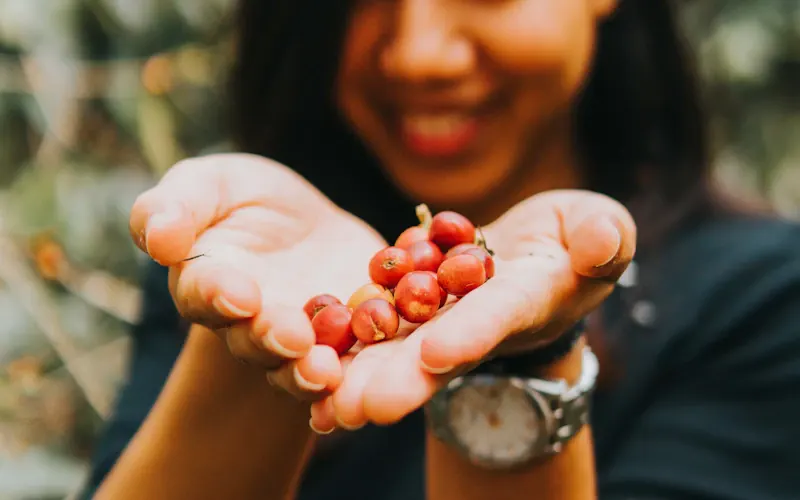
Brazil's signature specialty variety is the Yellow Bourbon (Bourbon Amarelo), a colour mutation of the traditional Red Bourbon that produces yellow cherries at ripeness. The yellow pigmentation signals an unusually high sugar concentration, which translates into cup sweetness, caramel depth, and a silky texture that few other varieties match at equivalent roast levels. Yellow Bourbon thrives in the red-clay soils of Cerrado Mineiro and Sul de Minas, and produces the round, harmonious profiles that have defined Brazilian specialty for the past two decades.
Catuaí (a Mundo Novo × Caturra hybrid, available in red and yellow) is the most widely planted variety in Brazil, reliable, productive, giving clean balanced cups excellent for espresso blending. Mundo Novo (Bourbon × Sumatra hybrid) offers high yields but rarely achieves the complexity of Yellow Bourbon in the cup. More recently, varieties like Arará (Bourbon × Timor), Acauã, and Icatu have been developed with disease resistance profiles that maintain quality cup scores, increasingly relevant as leaf rust pressure grows with climate change.
What makes Cerrado Mineiro such a natural espresso partner?
The Cerrado Mineiro, in western Minas Gerais state, holds a unique distinction: it was the first Brazilian coffee region to receive a Geographical Indication (2005) and then a Controlled Designation of Origin (2013), a first for coffee in the Americas. The production specification requires a minimum altitude of 800 metres (top zones reach 1,100-1,200 m), cherries harvested at full ripeness only, and natural or pulped natural processing with controlled drying. The dry Cerrado winter (May to September) makes natural drying highly reliable, uniform, slow, with minimal defect risk.
The Cerrado cup profile is distinctive and consistent: dark chocolate, toasted almond, brown caramel, with a soft low acidity and a full, lingering body. This is coffee that holds up in espresso, dense crema, good balance between sweetness and bitterness, excellent stability in milk drinks. The municipalities of Patrocínio, Araxá, Monte Carmelo, and Serra do Salitre concentrate the region's most reputed farms. For espresso lovers who find African origins too acidic, Cerrado Mineiro is often the gateway to Brazilian specialty.
Why is Sul de Minas Brazil's most diverse coffee region?
The Sul de Minas (South of Minas Gerais) is Brazil's single most productive coffee region, contributing around 30% of national production. Altitudes range from 900 to 1,350 metres, rainfall is 1,500-2,000 mm per year, and the landscape is a patchwork of thousands of small and medium fazendas, 5 to 100 hectares, that produces a diversity of micro-lots impossible in the large industrial farms of the Cerrado. The region's productive core lies in the municipalities of Três Pontas, Boa Esperança, Carmo de Minas, and Varginha (home of the Brazilian Specialty Coffee Association).
Sul de Minas specialty coffees read as: dried fig, sultana raisin, milk chocolate, candied orange, butterscotch. The pulped natural process, cherry depulped without fermentation, mucilage retained during drying, is the region's hallmark: it adds sweetness and body without the heavier fermented character of a full natural. Sul de Minas washed coffees are less common but interesting: brighter, with more citrus lift, they suit filter brewing well. The diversity of the region means that a Sul de Minas lot from Carmo de Minas tastes nothing like one from Varginha, terroir matters here too.
Where does Mogiana's smooth character come from?
Mogiana straddles the border between São Paulo and Minas Gerais states. Its name comes from the Companhia Mogiana de Estradas de Ferro, the railway that opened these lands to coffee farming in the late 19th century. Today, at altitudes of 900-1,200 metres, Mogiana produces coffees prized for their softness: hazelnut, roasted almond, white chocolate, mild citrus peel, gentle sweetness. It's the most "neutral" of the three regions, which makes it an exceptional blending component and a reliable espresso base, particularly appreciated by Italian and Belgian roasters who want body and sweetness without aggressive acidity.
Mogiana naturals, when carefully managed, add layers of dried apricot, sultana, and almond paste that enrich the espresso without disrupting its balance. The zone of Alta Mogiana (Pedregulho, Cristais Paulista) and the famous coffee town of Franca, renowned for its Yellow Bourbon Amarelo, are the addresses to know within the region. Franca's Yellow Bourbon has been fetching consistently strong Cup of Excellence scores for the past decade.
Natural, pulped natural or washed: how do Brazilian processes differ?
| Process | Description | Cup profile | Body | Best use |
|---|---|---|---|---|
| Natural (dry) | Whole cherry dried, 20-35 days | Chocolate, dried fruit, caramel | Full, creamy | Espresso, immersion |
| Pulped Natural (honey) | Depulped, mucilage retained | Caramel, hazelnut, brown sugar | Medium, full | Espresso, filter |
| Washed | Depulped + fermented + washed | Brighter, more citrus | Light, medium | Filter, pour-over |
How do you buy Brazilian specialty coffee in Belgium?
The Brazilian market is vast and quality varies enormously. To avoid paying specialty prices for commodity coffee, look for bags that name the specific region (Cerrado Mineiro, Sul de Minas, Mogiana, not just "Brazil"), the variety if available (Yellow Bourbon, Catuaí, Arará), the process (natural, pulped natural), the farm or fazenda if listed, and the roast date. An SCA score above 84 is a useful quality signal, comfortably beyond the 80-point line that defines specialty. The ideal purchase window for Brazilian coffee (harvested June to August) is October through March, when freshly roasted lots arrive in European roasteries.
Belgian specialty roasters regularly feature Brazilian origins as both espresso bases and filter single origins. For Cup of Excellence winners and auction lots, direct engagement with specialty importers or subscription roasteries is the most reliable route.
"Brazilian coffee taught me humility. I used to think altitude and complexity were the only things that mattered. Then I tasted a Yellow Bourbon natural from Cerrado, roasted light by someone who understood it, and realised that sweetness and harmony are just as valid as brightness and sparkle." Lorenzo, specialty coffee curator, expertcafe.be